
Table of Contents
- Introduction
- What's the Difference: Inground vs. Above Ground Pumps?
- Understanding Your Pool Pump
- Common Pool Pump Problems
- Inground Pump: Repair vs. Replace
- Above Ground Pump: Repair vs. Replace
- Pro Tip: Using an Inground Pump on an Above Ground Pool
- Variable Speed Pumps: Why They Pay for Themselves
- Best Inground Pool Pumps
- Best Above Ground Pool Pumps
- A Word on "Value" Pumps
- What to Avoid
- Electrical Requirements
- Frequently Asked Questions
- Final Thoughts
Introduction
Pool pump reviews around the web do little to educate you. Most are written by people who’ve never held a wrench, pushing whatever product pays them the highest commission. I’m offering an opinion based on 30 years of service work. My goal is to inform you and give you the straight talk nobody else will.
I’ve been repairing, installing, and otherwise working on pools for over a quarter century. In my first career, I was a master auto mechanic. So when I say I understand hydraulics, electronics, motors, and the mechanical aspects of machinery and their controls—that’s not marketing fluff. That’s thousands of pumps through my hands.
Look, I get it—your pump just died, your pool water clarity is on a clock, and you’re staring at prices trying to figure out if you should repair it or replace it. That’s exactly what this article is for. I’m going to tell you when it makes sense to fix what you’ve got, when you’re throwing money away on repairs, and when it’s time to upgrade. I’ll also tell you which pumps are actually worth buying—and which ones to stay away from.
Pool owners are overwhelmed by the options. Single speed, two speed, variable speed. Hayward, Pentair, Jandy, and now a flood of no-name brands on Amazon that didn’t exist two years ago. I’ll cut through the noise and narrow it down to what actually works.
What’s the Difference: Inground vs. Above Ground Pumps?
Let me clear something up because I’ve heard this enough times: “inground pump” does not mean the pump gets buried in the ground. An inground pump is a pump designed for an inground pool. The pump sits in your equipment pad like any other pump.
Here’s the real difference:
Inground pumps are self-priming. They can lift water even when the pump is located above the water line. This is necessary for inground pools because the equipment is typically installed at or above deck level. Inground pumps move serious water—around 80 gallons per minute and are self priming.
Above ground pumps are gravity-fed and non-self-priming. They rely on the water flowing downhill into the pump. That’s why above ground equipment sits below the pool’s water level / skimmer. These pumps move less water—typically 30-35 gallons per minute.
Why does this matter? Because you can actually use an inground pump on an above ground pool—and sometimes you should. More on that later.
Understanding Your Pool Pump
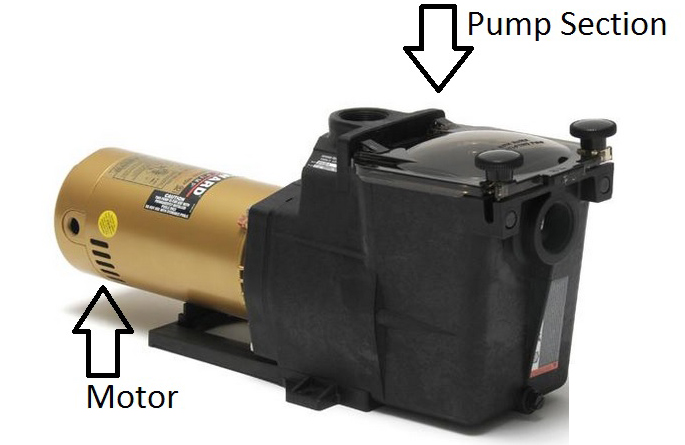
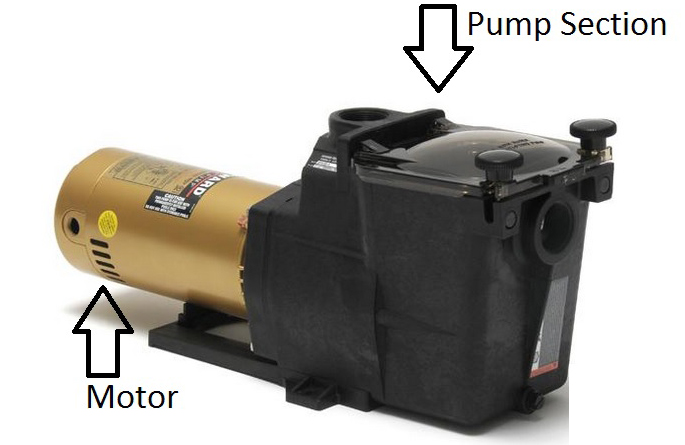
Before we talk repair vs. replace, you need to understand what you’re actually looking at. When I say “pump” in this article, I’m referring to the whole unit—the pump housing and the motor together. These are two separate components, and that matters when something breaks.
The pump (wet end) is the housing that contains the “pump-seal”, and impeller—the spinning part that actually moves the water. Pumps rarely fail. When they do, it’s usually a cracked housing or a worn impeller, and that’s uncommon.
The motor is what powers the impeller. This is what dies. Motors burn out, bearings seize, capacitors fail. When your “pump” stops working, 9 times out of 10 it’s actually the motor.
The seal sits between the pump and motor, keeping water from getting into the motor and seals the housing. This is the #1 wear item on any pool pump. When you see water dripping from where the pump meets the motor (middle), that’s a seal failure. The good news? Seal kits cost almost nothing and are easy to replace.
Now let’s talk about pump types:
Single Speed Pumps
Single speed pumps run at one constant speed—3,450 RPM. On or off, that’s it. If you haven’t replaced your inground pump in the last 15 years, you probably have one. They’ve been the industry standard for over 20 years. Reliable, cheap to buy, expensive to run.
The main problem with single speed pumps is energy consumption. They’re always running full blast even when you don’t need that much flow. They’re also loud, and that constant high speed beats up your filter media over time.
Two Speed Pumps
Two speed pumps give you high (3,450 RPM) and low (1,725 RPM). You run on low for daily filtration—which covers 70-80% of your runtime—and kick it to high when you need more flow, like when vacuuming or running a heater.
Better than single speed for energy savings, but not as good as variable speed. And here’s the thing—two speed pumps use two separate motor windings, so they’re still just as loud as single speed when running on high.
Variable Speed Pumps
Variable speed pumps are the real deal. They use a Permanent Magnet Motor (PMM) that can run at any speed you want—from barely moving water to full blast and everything in between.
They run quieter, cooler, and last longer than old-style motors. But the big win is energy savings. I’ll break down the math later, but you can save $200-400 a year depending on your electric rates and how much you run your pool. A variable speed pump pays for itself.
One more thing about variable speed: As of July 2021, federal Department of Energy regulations require variable speed pumps for most new installations and replacements (pumps over 1HP). Some states like California, Arizona, Florida, Nevada, and Texas have additional requirements. So if you’re replacing a single speed pump, you may not have a choice anymore—the law says variable speed. This isn’t a bad thing; it just means the government caught up with what we’ve known for years: VS pumps save energy and money.
Check for rebates: Many utility companies offer $200-500 rebates for installing ENERGY STAR certified variable speed pumps. In Massachusetts, Rhode Island, and New Hampshire, the rebate typically goes to the installer rather than the homeowner—but it’s worth asking about, and your state may be different. A quick call to your electric company before you buy could save you some money.
Common Pool Pump Problems
In 30+ years of service work, I’ve seen just about everything. Here’s what actually goes wrong with pool pumps:
Leaking seal (most common) – Water dripping from between the pump and motor. The seal wears out over time. Easy fix, cheap parts.
Motor won’t start – Could be the capacitor, could be the motor itself. Capacitors are cheap to replace. If the motor windings are fried, you’re looking at a motor swap.
Motor hums but won’t spin – Usually a bad capacitor or seized bearings. Try the capacitor first—it’s a $20-30 part.
Loud grinding or squealing – Bearings are going out. Motor replacement time, unless you want to deal with pressing in new bearings yourself.
Motor overheating/tripping breaker – Could be a bad capacitor, could be a dying motor drawing too many amps, could be inadequate ventilation. Check the simple stuff first.
Control board failure (variable speed only) – The electronics can go bad. Usually repairable by replacing the board, not the whole pump.
Notice something? The pump housing itself almost never fails. It’s always the motor, the seal, or (on variable speed units) the control board. This matters when you’re deciding whether to repair or replace.
Inground Pump: Repair vs. Replace
Here’s the decision tree I use after 30 years of doing this:
If It’s Just the Seal
Fix it. Always. Seal kits cost almost nothing—I can buy them for $3 at my cost. Even retail, you’re looking at $15-25. Any mechanically inclined person can do this job with basic tools and a YouTube video or your favorite AI (LLM). There’s no scenario where a leaking seal justifies replacing the whole pump.
If the Motor Is Dead on a Single Speed Pump
This is where it gets interesting. You can buy a replacement motor on Amazon for $189-400 depending on horsepower. That’s a huge savings compared to a $1,400 variable speed pump. So mathematically, the motor swap makes sense.
But here’s what you’re missing: A variable speed pump will save you $200-400 per year in electricity. So yes, you can drop $300 on a motor today—but you’re still running an energy hog. In 3-4 years, the variable speed pump would have paid for itself, and now you’re saving money every year after that.
My recommendation: If your single speed pump is over 5 years old and the motor dies, that’s your sign to upgrade to variable speed. If it’s newer and you just want to get through the season, a motor swap buys you time.
If the Motor or Board Is Dead on a Variable Speed Pump
Repair it. Variable speed motors and control boards can be replaced without buying a whole new pump. You’re already getting the energy savings, so it makes sense to keep the unit running. Most handy homeowners can handle a board swap—it’s usually just some screws and wire connections.
Above Ground Pump: Repair vs. Replace
Above ground pumps are a different animal. Here’s the reality: most above ground pumps are built to last 3-5 years. They’re cheaper, lighter duty, and frankly disposable by design.
If It’s Just the Seal
Fix it. Same as inground—seal kits are cheap and easy.
If Anything Else Is Wrong
Replace it. Don’t waste money on motor swaps or other repairs for above ground pumps. By the time you buy parts and put in the labor, you’re halfway to a new pump that will last another 3-5 years. These units just aren’t worth repairing beyond basic maintenance.
Pro Tip: Using an Inground Pump on an Above Ground Pool
Here’s something most people don’t know: you can run an inground variable speed pump on an above ground pool. And there are some real advantages to doing it.
Longer lifespan. Inground pumps are built heavier duty. Instead of replacing your pump every 3-5 years, you’re looking at 8-15 years.
Energy savings. Variable speed means you dial in exactly the flow you need. Since inground pumps move 80 GPM at full speed vs. 30-35 GPM for above ground pumps, you can run an inground pump at half speed or less and still move plenty of water.
Keep your above ground filter. Here’s the trick—you don’t need to buy an inground filter. Pair the inground pump with your existing above ground filter, just never run the pump above half speed. An inground pump at full blast would beat up an above ground filter, but at reduced speed it works great. For new above ground or semi inground pool shoppers this is a great consideration!
So you get the energy savings of variable speed, the longevity of inground equipment, and you don’t have to buy an expensive inground filter. That’s a win across the board.
One note: if you hear a knocking sound after installation, you may need to restrict the flow a bit to create more back pressure. Also, use PVC instead of flex hose—it’ll handle the pump better. Adding an extra return can help too.
Variable Speed Pumps: Why They Pay for Themselves
I need to explain something called the Affinity Law, because this is why variable speed pumps save so much money. It’s not intuitive.
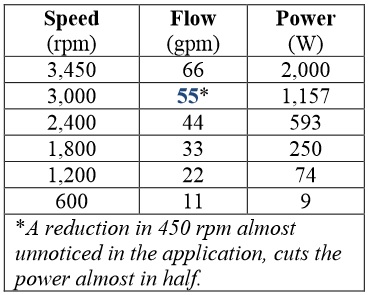
You’d think if you cut your pump speed in half, you’d cut your energy use in half. Makes sense, right? Wrong. The Affinity Law says energy consumption drops by the cube of the speed reduction.
In plain English: cut your speed in half, and you use about 1/8th the electricity. Not half—one eighth.
Let me give you real numbers. Say you have an average 25,000 gallon pool. A single speed pump running at 3,450 RPM pumps about 66 gallons per minute. It takes around 6 hours to turn over all your water. That pump consumes about 12,600 watts during those 6 hours.
Now take a variable speed pump running at 1,200 RPM. It’s only moving 22 gallons per minute, so it takes 19 hours to turn over the same water. But here’s the kicker—it only uses about 2,000 watts total. You’re saving over 10 kWh per day. Not to mention the extra hours of water surface skimming.
At average electricity rates around $0.17/kWh, running your pool for 120 days a season, that’s over $200 minimum in annual savings. If you have higher electric rates or run your pump longer, you could save $300-400.
Here’s another reason variable speed beats two-speed: Salt chlorine generators (SWG), heaters, and heat pumps all have minimum flow requirements to operate. If you run a two-speed pump on low, you might not trigger the flow switch on your SWG or meet the minimum GPM for your heater—so you’re stuck running on high anyway, killing your energy savings. With a variable speed pump, you dial in exactly the flow you need—enough to keep your SWG and heater happy, but not a drop more. That precision is where the real savings come from.
And here’s the other thing—running your pump at lower speeds actually gives you better filtration. High speeds push dirt into filter media instead of letting it catch properly. Your filter works better, lasts longer, and your water is cleaner.
And if you have a sand filter, here’s another problem with high speeds: The force of the water can actually push dirt particles through the sand and blow them right back into your pool. You’ll see a fine dust cloud coming out of your returns after the pump kicks on. Running at lower RPMs with a variable speed pump eliminates this completely—another reason your water stays cleaner with VS.
On the noise front: Single speed pumps run at 65-90 decibels—about as loud as standing next to a running lawnmower. Variable speed pumps at low RPM? 30-45 decibels. That’s the sound of light rain. I’ve walked into backyards where I had to touch the pump to make sure it was running. If your equipment pad is near a bedroom window or your neighbor’s fence, this alone might be worth the upgrade.
Best Inground Pool Pumps
I’m going to keep this simple because there’s really only one pump I recommend for inground pools right now:
Pentair IntelliFlo3 VSF (Model 011066) – $1,448 Free-Shipping
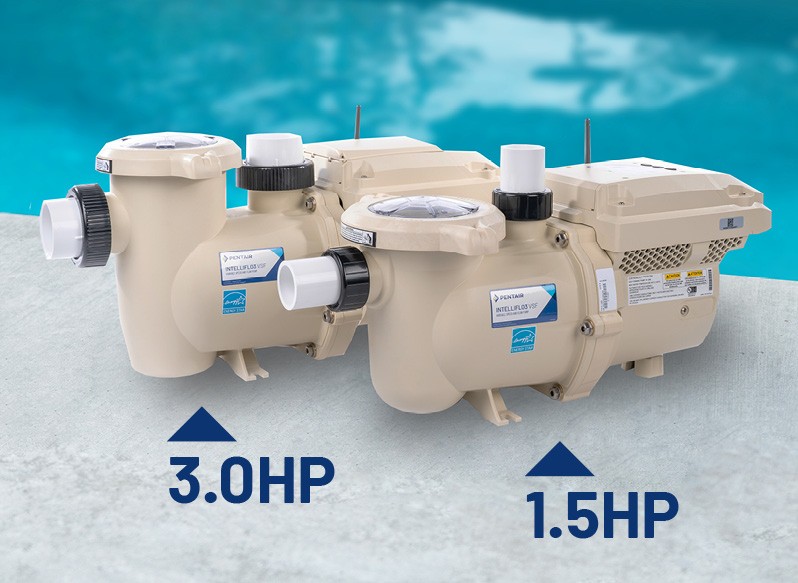
This is the one. Variable speed, variable flow, and it comes with Bluetooth, WiFi, and a relay to control another device—all controllable from your phone. You can monitor your pump, adjust speeds, set schedules, all from an app.
Pentair also makes the 342002 model, which is about $28 cheaper. Don’t bother. For $28 you lose the connectivity features. That’s not a savings, that’s just leaving features on the table.
I used to recommend the Speck A91 as a budget alternative. Not anymore. Post-COVID, quality went downhill and I’ve seen too many problems. Pulled my recommendation, and apologize if I sold you one.
Yes, $1,400 is real money. But you’re getting 8-15 years of life, $200-400 per year in energy savings, and smart home integration. Do the math—it pays for itself. Our store – Pentair 011066
Best Above Ground Pool Pumps
Above ground pumps have more options at different price points. Here’s what I recommend:
Speck E71-II Variable Speed – $727 (My Top Pick)
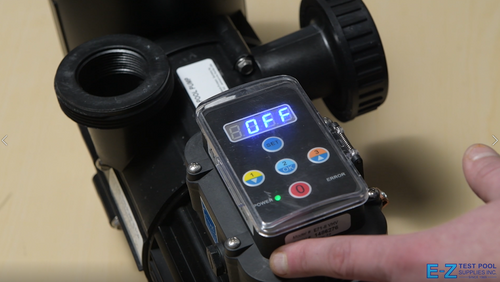
This is the best above ground pump on the market, and it’s not even close. Variable speed, programmable, and built better than anything else in this category. Fewer problems than Hayward two-speeds, longer life, better energy savings. Works with all filters, vertical or horizontal water discharge, direct form-factor replacement for Pentair or Hayward.
There is no above ground variable speed pump that can compete with the Speck E71-II for quality or price. None. If you can afford it, this is what you buy. Our Store – Speck E-71-ll
Hayward Matrix 2-Speed – $450
Solid mid-tier option. Two speed gives you some energy savings over single speed. I sell these for $450—Amazon usually charges $529-600 for the same pump. If variable speed is out of your budget, this is a good compromise. I can sell these so cheap because I buy a lot of Hayward XStream filter systems and pull these pumps out and replace them with Speck E71-ll pumps leaving me with these Hayward Powerflow Matrix Dual Speed Pumps Our Store – $450.00
SPLA 2-Speed – $350 (Budget Pick)
This is a Chinese pump, and I’m going to be straight with you—it outperforms the Hayward, which is also made in China now. Good quality for the money, two speeds, gets the job done. If budget is tight, this is what I’d buy.
A Word on “Value” Pumps
Go look at Amazon right now and search for pool pumps. You’ll see a flood of brands you’ve never heard of—names that didn’t exist two years ago and probably won’t exist two years from now.
I’m not saying Chinese manufacturing is bad. My SPLA pumps are from China and they’re great. Hayward moved production to China years ago. The issue isn’t where it’s made—it’s whether the company will be around when you need parts.
Think about it like this: One of the great things about old Chevy Cavaliers, or Ford Taurus’s was that they were everywhere. Parts were readily available and cheap because of the supply. Same principle applies to pool pumps—reliable, popular pumps have the same benefit when it’s time to repair.
That no-name pump might save you $50-100 upfront. But when it dies in 18 months—and it will—good luck finding a seal kit or replacement motor. You’re buying a whole new pump.
Remember: your pool is on a clock. When the pump dies, your pool starts going cloudy, then green. It doesn’t take long. You order a cheap pump to save money, it arrives DOA or dies in six months, and now you’re paying for a second pump PLUS the chemicals and labor to recover a green pool.
That’s not a value. That’s paying twice.
What to Avoid
Speck A91 Model – I used to recommend this pump. Not anymore. Post-COVID, quality tanked. I’ve seen too many failures and ongoing problems. Save your money.
No-name Amazon brands – If you can’t find the company’s website, can’t find replacement parts, and the brand name looks like someone mashed a keyboard (AquaFlow Pro 3000, SwimMaster Elite, etc.)—walk away. These companies rebrand pumps under new names constantly. When yours breaks, you’re out of luck.
Oversized pumps – Bigger is not better. An oversized pump doesn’t clean your pool faster—it just wastes electricity and beats up your equipment. Match the pump to your pool size and plumbing.
Electrical Requirements
Quick reference so you don’t burn your house down:
Above Ground Pumps
Most run on 115V service. For .75 HP to 1.0 HP pumps, you need a 15 amp circuit. For 1.5 HP pumps, you need 20 amps. Most above ground pumps come with a plug attached—just make sure you get the right plug type (standard or twist-lock) when ordering.
Inground Pumps
Most single speed inground pumps can run on either 110V or 220V—check the jumper setting on your new pump (most ship set to 220V). Variable speed pumps typically require 220V.
Breaker requirements: .75 HP needs 15 amp, 1 HP needs 20 amp, and 1.5-2 HP motors need 30 amp service.
If you’re installing new electrical service, go with 220V. It helps the motor run cooler and puts less strain on the unit during startup. Same energy usage either way, but 220V is easier on the equipment.
Frequently Asked Questions
Q: Is it worth repairing a pool pump?
A: Above ground pumps: Only if its a pump seal or cracked lid, or lid O-ring. Inground pumps: If your pump housing is cracked and the motor is old then its not worth repairing, if the pump is a one speed energy hog, it too is worth replacing if you can afford it. Otherwise yes repairing seal and even replacing the motor is way cheaper than a replacement.
Q: How much does a pool pump cost to repair?
A: Pump seal leak: DIY: $15-$35. Bring Pump in: $75-$150 Service at your home: $225- $350.
Pump Replacement: DIY: Cost of pump. Service at your home: $200 – $300. (+ pump)
New Motor: DIY: $200-$400. Bring Pump in: $75-$150 (+ pump). Service at your home: $225- $400 (+ motor)
Electrical Concerns: Bad timer, Bad breaker, Check with electrician. Many Pool service techs can diagnose and test electrical service, if they couldn’t i wouldn’t hire them
Q: Can a pool pump motor be repaired?
A: Yes!
Q: Can you replace just the motor on a pool pump?
A: Yes, however I don’t recommend it with above ground pool pumps
Q: What size pump do I need for my pool?
A: I’ve never seen an above ground pool that needed anymore than 1.5 HP, often .75 or 1HP do just fine.
Most Inground pumps don’t require more than 1-1.5 HP, unless you have waterfalls, hottubs, solar heater or accessories that require a little more flow. If your inground pump is far from the pool, or located several feet above the pool water, this increases “head pressure” and you should check with the pump manufacturer for appropriate sizing.
Q: What is the average cost to replace a pool pump?
A: Depends if you need to hire a service tech, and on the pump features and whether it’s an above ground, or inground pump.
Above ground pump cost: Single speed $185.00 – $300.00. Dual Speed $325-$600. Variable Speed $727.00 Plus service visit fee if you can’t replace it yourself.
Inground pool pump cost: Single speed $350-$800, Variable Speed $1200.00- $3000.00 Plus service visit fee if you can’t replace it yourself.
Q: What are common pool pump problems?
A: Leaky seals like the pump seal, and the lid seal. The motor hums but doesn’t turn.
Final Thoughts
Here’s the bottom line after 30 years of fixing these things:
If it’s just a seal—fix it, no question. Costs almost nothing.
If it’s an above ground pump with anything more than a seal problem—replace it. Not worth the repair cost on a 3-5 year life expectancy unit.
If it’s an inground single speed pump over 5 years old with a dead motor—that’s your upgrade moment. Variable speed pays for itself. If your selling your house, sure just swap out the motor.
If it’s a variable speed pump with a bad motor or board—repair it. You’re already getting the energy savings, keep it running. Unless its over 15 years old.
And whatever you do, don’t cheap out on a no-name pump without a good reputation of being reliable to save $50. Your pool is on a clock when that pump dies, and “value” that fails in a year isn’t value—it’s paying twice. Highly suggest Facebook market place for used equipment.
Thanks for reading. If you have questions or need help picking the right pump for your situation, reach out. That’s what I’m here for.