
Last Updated: November 2025
My Radiant Reviews title here is a bit clickbait like but I think you’ll thank me for it. This review comes from someone who’s seen just about every pool ever made. In 30+ years, I’ve been a dealer for multiple pool lines, installed Doughboy and Swim n Play pools (now gone?), and I’ve repaired or replaced liners on everything from modern polymer and steel walls to old wood wall pools from the 60’s and 70s. I am a semi inground pool specialist.
So, when I tell you I can’t recommend Radiant Pools, it’s not because I read some reviews online. It’s because I’ve seen them fail in person. I want to also call out my conflict of interest and confess to why I’m being so helpful in providing this review. Really its a win win, for you and me! I want to sell you a better pool at a better value, and well you want a great product. You will see the evidence for yourself, you don’t even need to read this article just look at the pictures and short video on this page.
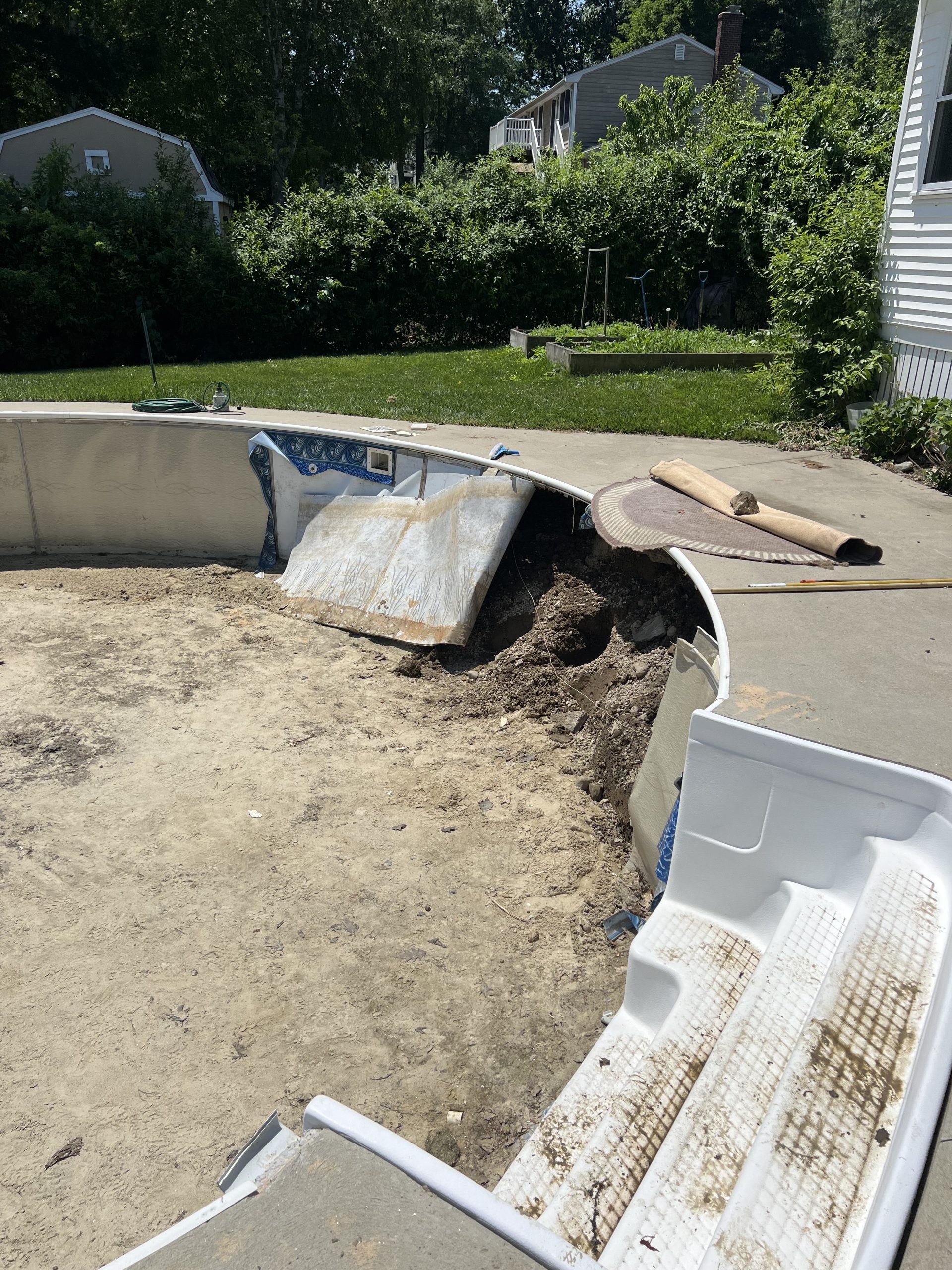
Earlier this year (2025), I got a call about a Radiant pool that had completely caved in. The pool was only three years old and had been used for just two swimming seasons. The homeowner was devastated (located in Peabody MA). They’d paid premium money for what they thought was a premium pool.
When I excavated the site, I found something interesting: the concrete collar had been poured perfectly. The installer did everything right. The problem was the pool design itself.
Before I explain what went wrong, let me address something else. Radiant’s Google reviews currently sit at 2.4 stars. I wouldn’t stay in a 2-star hotel. Why would I put a 2-star pool in your backyard?
If you want the look of this pool, and the features and benefits, in a stronger version – Please see the top 3 pools I recommend in my best above ground pools of 2026 article – here.
What Is a Radiant Pool?
A Radiant pool looks impressive when the dealer shows you a sample of the wall. It’s about two inches thick and feels substantial in your hands.
Here’s what they often don’t emphasize: that two-inch wall is a piece of styrofoam sandwiched between two very thin sheets of aluminum.
I have no problem with aluminum pools. I sell them, I recommend them. But the aluminum sheets in a Radiant pool are crazy thin. If you ask the dealer to unbend the folded edge at the top or bottom as i did in this video, you can compare the thickness to a dime. Go to time 14:18 on this video https://youtu.be/nDZdb5jSd6k?si=g3LWS0tBjjOggtAx
The bigger problem? Styrofoam as structural support. You wouldn’t build a house with styrofoam walls and expect them to hold up the roof. But that’s essentially what’s happening here – styrofoam trying to hold back thousands of pounds of water and earth pressure.
The Design Has Been Failing Since the 1970s
Here’s something most people don’t know: Radiant didn’t invent this design. They copied it from a company called Dover Pools that operated back in the ’70s.
My friend and original pool mentor Dave has been in the pool business way longer than I have. He told me he used to keep a sample section of Dover wall that he’d salvaged when replacing failed Dover pools. The construction was nearly identical to Radiant: thin aluminum sheets around a Styrofoam core.
If a design has been failing for 50+ years under different brand names, that should tell you something.
What Went Wrong With That Three-Year-Old Pool
When we dug up the failed Radiant pool, I took photos of everything. The wall had caved in dramatically, creating a dangerous situation in the backyard.
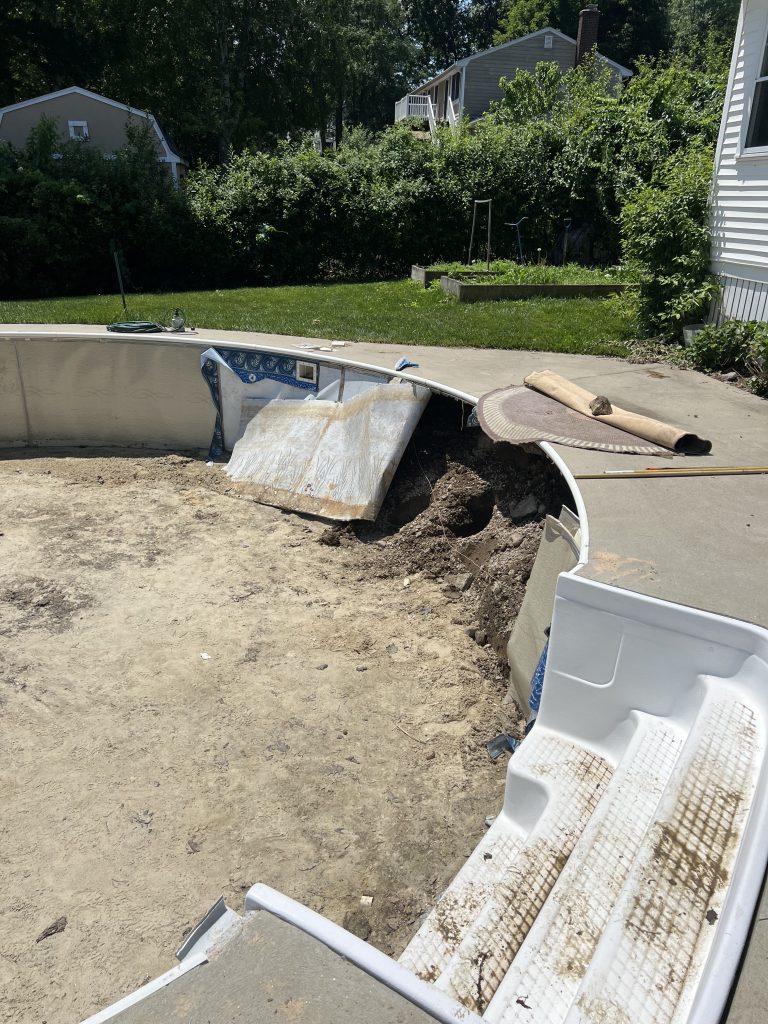
The concrete collar was perfect. The installation was done correctly. So what happened?
Radiant pools have no mechanical anchor to hold the wall in place. The wall just sits on the ground and a cement collar is poured around the base of the outside of the wall. There’s nothing locking it down. When lateral pressure builds up – from earth, from water, from freeze-thaw cycles – the wall has nothing to keep it from kicking inward. honestly this pool that failed was a 30 round (actual measurement turned out to be much closer to 29), the point I’m making is that the wall was an arch, arches are ridiculously strong, but not their Styrofoam cladded with thin aluminum.
Think about building a fence. You can dig a hole and drop a post in and cement it, or not dig a hole and put cement around the surface, that fence post is gonna kick.
The Ice Damage Problem
The catastrophic failure wasn’t my first warning sign about Radiant pools, or advise from a man 20 years my senior who has forgotten more than ill ever know. I’ve documented multiple cases of ice damage on these pools.
When water freezes, it expands with tremendous force. I’ve seen clear denting and deformation in Radiant pool walls right at the waterline where ice pushed against the thin aluminum backed by beer cooler not earth.
One case really stood out: an oval Radiant pool in New Jersey that was only one year old. It had been through just one winter, and the ice damage was already visible and significant.
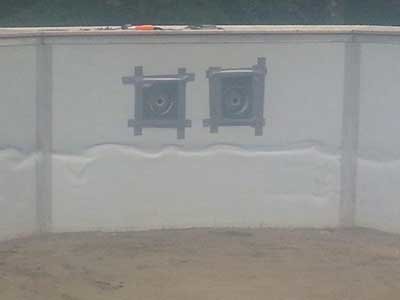
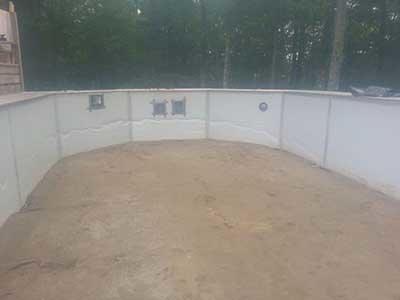
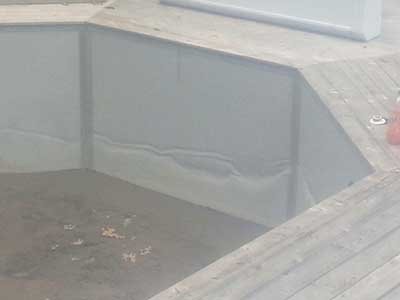
A former Radiant dealer shared these photos with me showing this same pattern across multiple installations. The thin aluminum simply can’t handle the forces of a New England winter.
What I Installed Instead: The Fox Ultimate Pool
The homeowner asked me what I’d recommend to replace their failed Radiant. I suggested building the Fox Ultimate, inside the failed Radiant, and here’s why it’s completely different.
How the Fox Ultimate Solves the Problem
The Fox Ultimate uses 14-gauge powder-coated steel panels (hello , remember steel). That’s substantially stronger than thin aluminum sheets around Styrofoam.
But here’s the game-changer: we drive multiple 18-inch rebar stakes through pre-drilled holes in the bottom of every wall panel. About 3 inches of rebar sticks out. When we pour the concrete collar at the base, that rebar gets completely locked into the concrete and is anchored into the earth with rebar.
Think about that fence post analogy again. Now imagine driving a steel stake through the bottom of the post before pouring concrete around it. Obviously you dig a hole, but you get the point. That post isn’t going anywhere. That’s the Fox Ultimate design.
The failed Radiant pool? We found the concrete collar perfectly poured. The installer did everything right. But without rebar anchoring the wall, the design was doomed from the start. not to mention we saw signs of buckling in a lot of the panels that hadn’t failed yet.
The homeowner chose the Fox Ultimate because he wanted the built-in inground step that’s integrated into the wall like the Radiant. It gives you that true inground pool feel.
We ship Fox Ultimate pools within 200 miles and install them professionally in our service area (see contact page for service area). The finished result speaks for itself – a beautiful, structurally sound pool that won’t cave in after three years.
The Semi Inground Pool I Recommend Most: Aquasport 52
Here’s the truth: we install the Aquasport 52 about five times more often than the Fox Ultimate. It’s our go-to recommendation, and for good reason.
The Aquasport 52 doesn’t need a concrete collar at all.
This award-winning design has a thick aluminum bottom track that locks the wall in place. No concrete collar means:
- No concrete material costs
- No labor & Material’s for pouring concrete (($2500 in saving on the install)
- Faster installation
- Thousands of dollars in savings on the cost of the kit as well
The Aquasport 52 costs less to buy than a Radiant pool AND costs thousands less to install.
The only thing it doesn’t have is the built-in inground step option. If you don’t need that step, the Aquasport 52 is the smarter choice, if you do want the step, think Fox Ultimate.
We ship Aquasport 52 pools nationwide. I’ve walked hundreds of DIY homeowners through their installations over the phone. We’ve never had a failure. Not one.
Why These Pools Work Better
It comes down to what’s behind the wall. Radiant uses styrofoam as backing material. Styrofoam provides virtually no structural support.
You wouldn’t insulate your house with styrofoam and expect it to be load-bearing, would you? But that’s what Radiant is asking you to trust.
If Radiant took their 2 aluminum sheets and made them much thicker – eliminating the styrofoam entirely – the earth backfill itself would provide better support. But with styrofoam as the backing material, you essentially have a beer cooler trying to hold back thousands of pounds of pressure. No Bueno!
Both the Fox Ultimate and Aquasport 52 use solid wall construction backed by earth, or even better compactable material (not styrofoam). That’s what you need for long-term durability.
The Finished Result
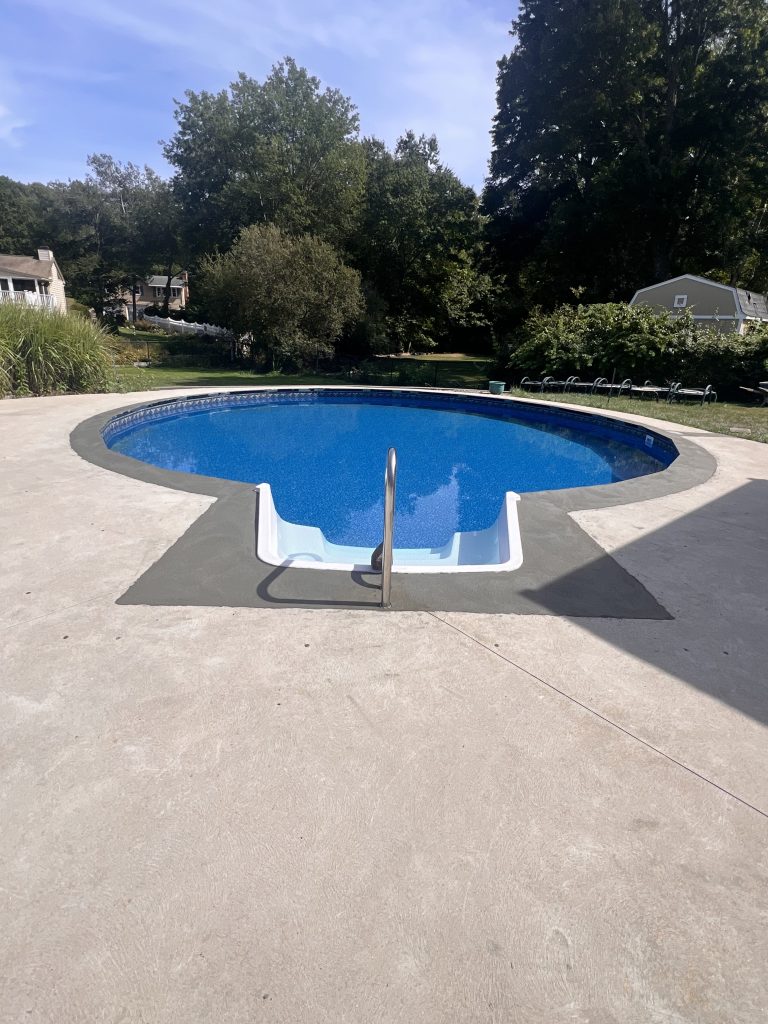
The transformation was remarkable. The same homeowner who had watched their Radiant pool collapse now has a beautiful, structurally sound Fox Ultimate pool with integrated steps. The installation went smoothly, and the finished product speaks for itself.
The homeowner was originally going to do a bullnose paver coping, but later went with this poured concrete. Despite the look you can see that we set the pool wall higher so rain and dirt no longer washed into his pool. Brilliant!
The Cost Problem With Radiant Pools
Radiant pools are significantly more expensive than better alternatives. You’re paying premium prices for:
- Thin aluminum walls with styrofoam filling
- No rebar anchoring system
- A design that’s been failing since the 1970s
- Proprietary accessories that force you to buy from the dealer
The Warranty Trap
Radiant advertises a lifetime warranty. Sounds great, right?
Here’s what they don’t tell you: even if they give you replacement wall panels under warranty, you still pay for:
- Excavating the entire pool
- Removing the failed sections
- Installing the new panels
- A brand new liner
- Refilling and rebalancing the pool
- They are not covering labor or even shipping the new panels, just stop!
That’s thousands & thousands of dollars out of your pocket, even with a “lifetime warranty.”
The homeowner I helped in Peabody got caught in a worse situation. The manufacturer blamed the installer. The installer blamed the manufacturer. The warranty covered nothing. After just three years, he paid for a complete pool replacement.
He told me he was shocked at how reasonable my price was for the Fox Ultimate replacement – especially after everything he’d been through.
What About Optimum and Other Similar Pools?
You might see other brands that look like Radiant pools. Optimum is one example. These are basically the same design with minor changes.
Optimum supposedly uses more environmentally friendly glue in manufacturing. That’s nice, but it doesn’t fix the fundamental problem: thin aluminum sheets around styrofoam with no mechanical anchoring.
My recommendation is the same regardless of the brand name: avoid pools with this design.
My Bottom Line Recommendation
I’ve installed pools for 30 years. I’ve been a dealer for multiple pool lines. I’ve repaired everything from modern polymer and steel walls to old wood wall pools from the ’70s.
The most expensive repair is the one you shouldn’t have needed in the first place.
That homeowner with the collapsed Radiant pool lost a season and a half of memories enjoying the pool with his family. He dealt with a dangerous situation in his backyard. He went through the stress of complete pool replacement. And he got stuck with the entire bill when the warranty covered nothing. in football we call that: C’mon man!
If you’re considering a Radiant pool, ask these questions:
- Can I see the actual thickness of the aluminum (not the total wall thickness with styrofoam)?
- How is the wall anchored to prevent it from kicking inward? if they say water pressure, try again, what happens during a liner replacement? The old wood wall pools caved in when the water came out!
- What happens with ice expansion in cold climates?
- If something goes wrong, what costs am I responsible for under warranty?
- What’s the total installed cost including the concrete collar?
Then compare those answers to the Fox Ultimate or Aquasport 52.
For customers in Massachusetts, Southern New Hampshire, Eastern Connecticut, and Rhode Island: We install both Fox Ultimate and Aquasport 52 as well as other great pools professionally.
For DIY customers nationwide: We ship the Aquasport 52 and provide phone support throughout your installation. The bottom track design eliminates the concrete collar, making it achievable for DIYers and saving you thousands.
For customers within 200 miles: We can ship Fox Ultimate pools. Professional installation is strongly recommended due to the concrete collar and rebar requirements.
After seeing that Radiant failure firsthand, documenting ice damage across multiple installations, and knowing this design has been failing since Dover Pools in the 1970s, I can’t recommend Radiant pools when better alternatives exist at comparable or lower cost.
Frequently Asked Questions About Radiant Pools
What is a Radiant Pool?
A Radiant Pool is a semi-inground or inground pool with a wall made of styrofoam sandwiched between two thin aluminum sheets. The design came from Dover Pools back in the 1970s and has been sold under different brand names since then.
The manufacturer talks about the styrofoam insulation being good for heat retention. The wall looks thick (about 2 inches) when you see a sample. But the actual aluminum sheets are very thin.
Radiant pools need a concrete collar poured around the base during installation. This adds significant cost compared to pools with bottom track systems.
Are Radiant Pools worth the money?
No. Based on 30 years of experience, I can’t recommend them.
They cost more than better alternatives. You’re paying premium prices for thin aluminum walls with no mechanical anchoring system.
The warranty looks good but doesn’t really protect you. Even if they give you replacement panels, you pay for excavation, demolition, installation, a new liner, and refilling. In the case I saw, the warranty covered nothing because the manufacturer and installer blamed each other.
Installation costs more because you need a poured concrete collar. The Aquasport 52 uses a bottom track design that eliminates this expense, saving thousands.
They don’t last. The ice damage I’ve documented and the three-year-old pool that completely caved in prove the design has serious problems.
Do Radiant Pools really last forever and never rust?
The manufacturer claims: “Made from the highest quality materials that will last forever. All aluminum components make this pool completely rust free. It will never rust, warp or crack – we guarantee it. Tested and proven for over 60 years!”
Let me address each claim:
“Last forever” – Youve now witnessed my tiny case study in one tiny area of the country. The three-year-old pool that caved in didn’t last forever. The pools with ice damage after one winter didn’t last forever. I’ve been replacing failed Dover pools (same design) since the ’70s, well not me personally, i was born in 69.
“Never rust” – Aluminum doesn’t rust. That’s true. But this claim distracts from the real problem: the aluminum is too thin and the Styrofoam provides no structural support. Who cares if it doesn’t rust when the wall caves in? not to mention aluminum oxidizes (hello).
“Never warp or crack” – My photos show warping from ice damage. The catastrophic failure shows the wall collapsing inward. These failures are worse than simple cracks.
“Tested and proven for over 60 years” – This is misleading. Yes, this design has existed since Dover Pools in the 1970s (about 50 years). But it’s been failing consistently for those 50 years. “Tested and proven” should mean it works, not that it fails repeatedly under different brand names.
Read the warranty details carefully. What does it actually cover? Who pays for labor? What happens when manufacturer and installer point fingers at each other? These questions matter more than marketing promises.
What are better alternatives to Radiant Pools?
I recommend two alternatives depending on what you need:
Fox Ultimate – Uses 14-gauge powder-coated steel panels with 18-inch rebar stakes driven through the bottom. The rebar locks into concrete and earth to prevent wall kick-in. Choose this if you want the built-in inground step. We ship within 200 miles and install professionally in our service area.
Aquasport 52 – Our most popular choice (we install these 5 to 1 over Fox Ultimate). Award-winning design with a thick aluminum bottom track that locks the wall without needing a concrete collar. Saves thousands in installation costs. We ship nationwide and provide phone support for DIY installations. We’ve never had a failure.
Both cost less than Radiant pools when you factor in total costs. Both have superior structural integrity.
Can I install a Radiant Pool myself?
Technically yes, but I don’t recommend it.
If you want to save money with DIY installation, the Aquasport 52 is the better choice. The bottom track design makes it doable for DIYers. We provide phone support. And the thousands you save by not needing a concrete collar more than makes up for any price difference.
Do Radiant Pools work in cold climates?
This is my biggest concern, especially in New England.
I’ve documented multiple cases of ice damage on Radiant pools. One oval pool in New Jersey showed significant wall deformation after just one winter. When water freezes, it expands with tremendous force. The thin aluminum can’t handle this pressure without denting and warping.
The styrofoam core might help with insulation, but it provides zero structural support against freeze-thaw cycles. A pool wall needs to be strong first and insulated second. Radiant prioritizes the marketing appeal of insulation over structural integrity. I don’t blame consumers either, because the story is good and the sample does look very robust!
Both Fox Ultimate and Aquasport 52 handle New England winters without problems. Solid wall construction backed by earth (not styrofoam) is what you need for cold climates.
Questions? Let’s Talk
Every property is different, and I understand that choosing a pool is a significant investment. If you’re in our service area (Massachusetts, Southern New Hampshire, Eastern Connecticut, or parts of Rhode Island) and want to discuss your specific situation, I’m happy to provide a honest assessment.
We carry multiple pool lines specifically because different situations call for different solutions. But after seeing that Radiant failure firsthand and documenting the ice damage across multiple installations, I can’t in good conscience recommend them when better alternatives exist at comparable or lower prices.
Your pool should bring you decades of enjoyment, not stress and expensive repairs. Choose accordingly.
Michael G. Kern operates MGK Pools Inc, specializing in above-ground and semi-inground pool installation throughout Massachusetts, Southern New Hampshire, Eastern Connecticut, and Rhode Island. With over 30 years of experience, Mike has installed hundreds of pools and provides honest, experience-based guidance to help homeowners make informed decisions.