
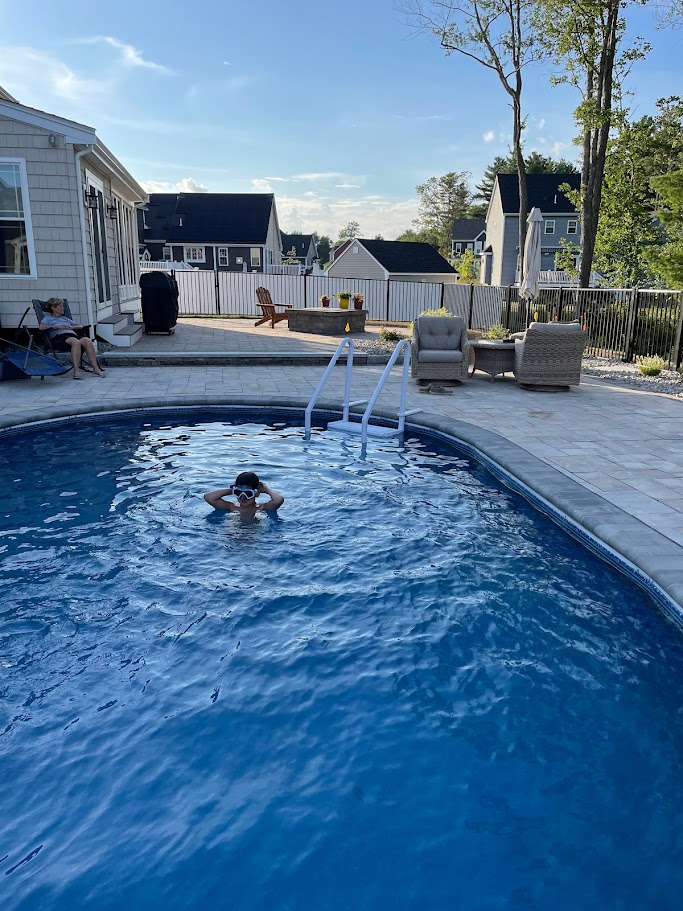
You wanted an inground pool. You got some quotes. The numbers started at $65,000 and climbed from there. Maybe they hit $80K. Maybe $100K. Your jaw hit the floor, and you started Googling alternatives.
How do I know? That’s what I hear from about 80% of my semi-inground customers that find me. They wanted inground, couldn’t stomach the price, dead set against above ground, and discovered there’s a category of pool that looks like inground, functions like inground, and costs a fraction of the price.
I’ve been installing both semi-inground and traditional pools for over 30 years. Let me walk you through the honest comparison — what you gain, what you give up, and what nobody tells you about either option.
The Price Gap Is Staggering (And Getting Worse)
Let’s start with the elephant in the room. Here are real, current numbers — not ranges from a blog that’s never sold a pool:
| Pool Type | Complete Project Cost |
|---|---|
| Semi-inground (Aquasport 52, round/oval) | $15,000–$25,000 |
| Semi-inground (Fox Ultimate, all shapes) | $20,000–$55,000 |
| Fiberglass inground | $50,000–$100,000 |
| Vinyl liner inground | $65,000–$95,000 |
| Concrete/gunite inground | $85,000–$150,000+ |
Those inground numbers include excavation, the pool, installation, plumbing, basic cement patio, electrical, and permits. They don’t include landscaping, fencing, or upgrades — which easily add another $10K–$30K.
The gap between a semi-inground Aquasport 52 and a basic concrete inground pool is $70,000–$125,000. That’s a new truck. That’s a kitchen renovation. That’s a condo in Thailand. That’s your kid’s college fund.
And here’s the thing that pool builders don’t want you to know: from the patio, looking at the water, if done right, nobody can tell the difference.
What You’re Actually Comparing
When people say “inground pool,” they usually mean a concrete (gunite), fiberglass, or vinyl liner pool that’s completely flush with the ground. The top of the pool wall is at patio level. You step off the deck and onto a step or ladder into the water.
A semi-inground pool achieves the same thing — if you bury it to grade level. Both the Aquasport 52 and the Fox Ultimate are designed to be installed completely inground. With the right coping (the finished edge around the pool), an inground skimmer, and a proper patio, the result is visually identical.
The construction is different. The materials are different. The price is different. But the swimming experience? The view from the lounge chair? The impression your neighbors get? Longevity? Identical.
I have customers who’ve had their semi-inground Aquasport 52 pools for years and their neighbors still think it’s a $50K inground pool. The Tom from Framingham testimonial on my Aquasport 52 page says it best: “Neighbors think it’s a $40K inground pool.” He installed a 21-foot round himself using my videos. (kit price $7139 now – Then $5950)
The Honest Comparison: What You Gain
1. You Save a Fortune
I’m not going to belabor this point — you’ve seen the numbers. A semi-inground Aquasport 52 installed in the ground costs $15K–$25K complete. The cheapest inground pool you’ll find is $50K, and that’s a basic vinyl liner with minimal patio, or tiny fiberglass. The savings are real and they’re significant.
2. Installation Is Faster
A concrete inground pool takes 8–18 weeks from dig to swim. Sometimes longer if weather doesn’t cooperate or inspections get delayed. You’re living in a construction zone for months.
A semi-inground Aquasport 52? Excavation and installation typically take 3–5 days for professional installation. You could be swimming the same week the excavator shows up. Even the Fox Ultimate with its concrete collar is done in 1–2 weeks.
3. Better Design for How People Actually Use Pools
Here’s something I talk about on my semi-inground buyer’s guide that blows people’s minds:
Traditional inground pools have a shallow end (3 feet) and a deep end (6–7 feet) with a slope between them. Sounds great in theory. In practice? You’re either standing in water up to your thighs or treading water over your head. Don’t get me started with the dangers of the slope where young ones can quickly find themselves in over their heads. The actual usable swimming area — where you can stand comfortably and enjoy yourself — is a small strip on the slope.
Semi-inground pools are flat bottom at approximately 4 feet of water depth. The entire pool is usable. You can play volleyball. You can float on a raft without drifting into the deep end. Your kids can stand and play everywhere, not just in the shallow corner.
And that deep end? I’ve been doing this for 30 years. Know what happens when people replace their old inground pool’s liner? They ask me to fill in the deep end at least 40% of the time. Turns out nobody uses it. The diving board era is over (most home insurance companies won’t even cover you). People want pools they can use, not pools they can survive.
4. Perfect for Sloped Yards
If your yard has any slope at all, a semi-inground pool has a massive advantage. It adapts to the grade naturally — buried deeper on the high side, more exposed on the low side. An inground pool needs the entire area graded flat, which can add $10,000–$30,000 for hardscaping retaining walls on a significant slope.
I wrote an entire guide about this: Semi-Inground Pool on a Sloped Yard
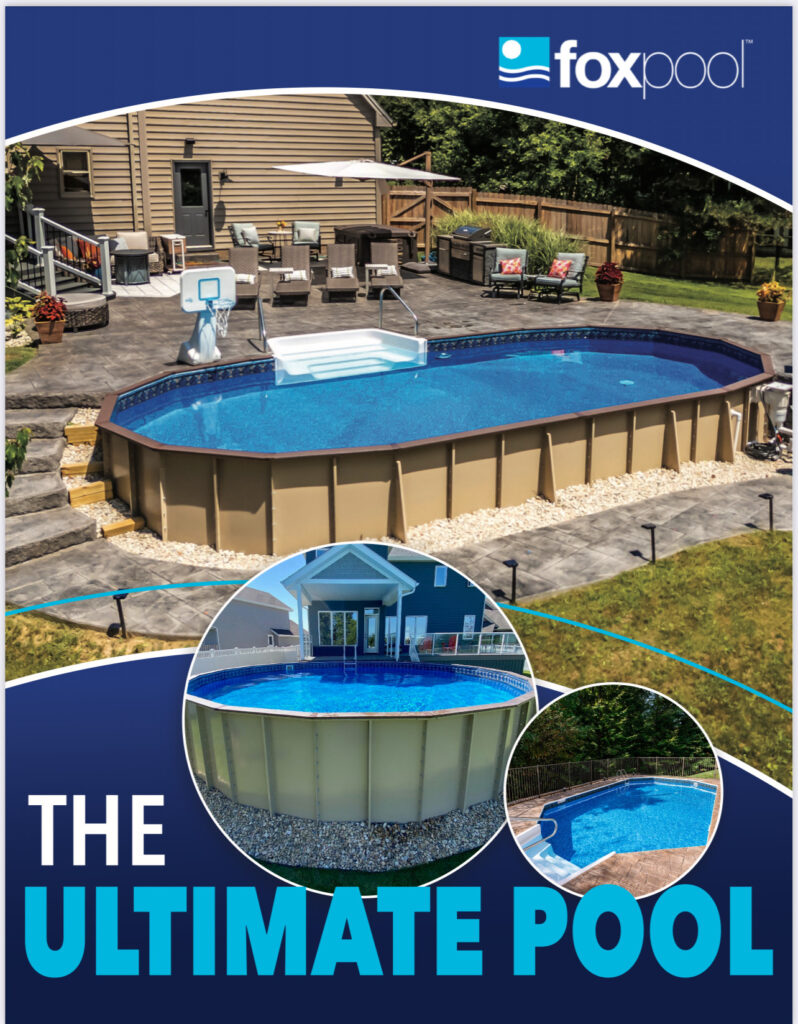
5. Less Complicated Permitting (Usually)
Inground pools often trigger more complex permitting requirements — engineering stamps, soil reports, deeper setback requirements. Semi-inground pools, depending on your municipality, sometimes fall under the same permitting as above ground pools. This varies by town, so always check locally, but it’s one less headache in many cases.
The Honest Comparison: What You Give Up
I’m not going to pretend semi-inground pools are perfect. Here’s where an inground pool genuinely wins:
1. Shape Flexibility
The Aquasport 52 comes in rounds and ovals only. If you want a freeform kidney shape, a beach entry, or an L-shape, it can’t do that.
The Fox Ultimate adds grecian and rectangle shapes, which covers most people’s needs. But if you want a totally custom shape, you need fiberglass (pre-molded shapes) or concrete (any shape you can dream up).
That said, most people vastly overestimate how much shape matters. After the first month, nobody cares that your pool is round instead of kidney-shaped. They care that the water’s clean and the beer’s cold.
2. Depth Options
Semi-inground pools are flat-bottom at approximately 4 feet (measured from the top of the water down). You can’t add a deep end, a tanning ledge, or a graduated entry. It’s 4 feet everywhere.
If you absolutely must have a deep end for diving (note: most municipalities now require 9+ feet for diving boards, which most residential pools can’t accommodate anyway), you need an inground pool at a minimum of 18’x36′.
3. Size Limits
The largest Aquasport 52 is a 17×32 oval. The largest Fox Ultimate is a 20×40 rectangle. These are substantial pools — a 20×40 rectangle is 25,200 gallons — but they’re not as large as the biggest custom inground pools.
For most residential backyards, though, these sizes are more than adequate. A 17×32 oval or 16×32 rectangle is a big pool. You might be surprised to hear the most common sizes are actually: 12×24, 15×30, and 21, 24 rounds.
4. Resale Value Perception
Here’s the one downside I can’t sugarcoat: some real estate agents and home buyers perceive semi-inground pools as “just an above ground pool that’s buried.” This is technically wrong — the construction is completely different — but perception matters in real estate.
That said, a well-finished semi-inground pool with quality coping, a nice patio, and professional landscaping adds significant value to a home. The key is the finish, not the pool type. A gorgeous semi-inground with a $10K patio adds more value than an ugly concrete pool with cracked decking.
Don’t discount inflation, no matter what, nobody will ever buy a less expensive pool. When I started a great vinyl inground pool cost just 17k soup to nuts. So Having that pool in 20 years on any kind in good shape is a positive.
5. Longevity Edge (Slight)
A well-maintained concrete inground pool can last 50+ years. Semi-inground pools, depending on the model, typically last 30–35+ years. The Aquasport 52’s aluminum panels won’t rust, but the liner will need replacement every 10–15 years. The Fox Ultimate’s has 14 gauge steel powder coated panels. I’d put them up against any vinyl lined inground pool, but concrete gets an edge.
For most homeowners, 30–35 years is more than enough. You’ll probably sell the house before the pool fails.
The Math Nobody Does
Here’s the calculation that should end this debate for 90% of people:
Concrete inground pool:
- Pool + installation: $85,000
- Resurfacing at year 9-15: $10,000
- Acid wash every 3 years: $900 × 10 = $9,000
- Higher insurance premium: $200/year × 30 years = $6,000
- 30-year total: ~$110,000
Semi-inground Aquasport 52 (fully buried):
- Pool + installation: $20,000
- Liner replacement at year 12: $1,500
- Liner replacement at year 24: $1,500
- Standard insurance: minimal impact
- 30-year total: ~$23,000
Savings over 30 years: $72,000.
Even if you need a second semi-inground pool at year 25 (unlikely with the Aquasport 52’s aluminum panels), you’re still $50,000 ahead.
How to Make a Semi-Inground Pool Look Completely Inground
If you’re going to make the switch from an traditional inground plan to a semi-inground, here are the finishing touches that sell the illusion:
Use an inground skimmer. The Aquasport 52 comes with an above ground skimmer standard, but for $279 I upgrade it to an inground skimmer. This sits flush in the pool wall instead of hanging over the top rail. It’s the single biggest visual difference between “above ground that’s been buried” and “looks like an inground pool.”
Install proper coping. Coping is the cap that goes on top of the pool wall where it meets the patio. The Fox Ultimate offers three coping options: Trex composite top plate, 4-inch coping for pouring cement against, or a bead receiver for stone pavers. Any of these create the clean, finished edge that says “inground.”
Pour a concrete or paver patio flush to the coping. This is non-negotiable if you want the inground look. The patio should come right up to the pool edge with no gap.
Consider the Fox Ultimate’s in-wall step. If budget allows, the $3,400 inground step integrated into the Fox Ultimate’s wall is the ultimate finishing touch. It’s a 5-tread thermoplastic stair built into the pool wall — exactly like a traditional inground pool’s entry. Nobody will ever question whether it’s “really” an inground pool.
Stone veneer any exposed wall sections. If any part of the wall is above grade (on a slope, the downhill side will be), covering it with stone veneer transforms it from “pool wall” to “landscape feature.”
Who Should Still Get an Inground Pool?
I sell semi-inground pools for the most part, but I’m not going to pretend they’re right for everyone. Get a traditional inground pool if:
- You want a freeform or custom shape that doesn’t come in a panel pool
- You absolutely need a deep end (8+ feet)
- You want a pool larger than 20×40
- Budget is not a factor and you want maximum customization
For everyone else — which is most people — a semi-inground pool delivers 90% of the inground experience at 30–60% of the cost.
What I Recommend
If you’re reading this, you probably came from a sticker-shock Google search. Here’s my honest advice:
If your inground quote was $50K–$70K: Look at the Fox Ultimate. For $30K–$55K total, you’ll get the same look — especially if you spring for the inground step and quality coping. You’ll save $15K–$25K easy and have a pool that’ll last 40+ years.
If your inground quote was $65K–$100K+: Look at the Aquasport 52. For $15K–$25K total, you’ll have a pool that looks like it cost three times the price, with the savings to build an incredible patio and outdoor living space around it.
If you were already leaning above ground but want more: The Aquasport 52 semi-inground is the bridge. Same pool as above ground, buried to look like inground, at a total project cost that’s reasonable for most families.
Compare the Aquasport 52 and Fox Ultimate side by side →
Or just call me: (978) 710-8667. Tell me what your inground quote was and I’ll tell you what I can do for less. No salespeople. No BS. Just 30 years of experience and honest numbers.
FAQs
Is a semi-inground pool really worth it, or will I regret not just spending the money on a real inground pool?
1st: If you don’t hire a good installer/pool builder/contractor, it doesn’t matter what pool you buy! 2nd: All inground pools require a permit, and you will not get one without a pool that passes all safety and engineering standards. 3rd: If you try to bury a real above ground pool, you very well may regret it. 4th: I tell people all the time it’s not the pool that looks good, it’s the patio and landscaping, and if you spend less on the pool, you can get more of what matters.
Where are the savings actually coming from? Why is a semi-inground so much cheaper if it’s basically the same thing?
This is coming from someone who also sells fiberglass pools. Fiberglass pools just cost a lot to buy, Small shells are 15k medium 25k, and large 35-40k and shipping fees are ridiculous think 3k-9k, and you may need a crane, and they require thousands more in backfill. Traditional Vinyl pools require more labor, materials and time. Don’t get me started with all the concrete, rebar, labor and time it takes to build a Gunite pool. I install most Aquasport 52 pools in one day, hello! Also, I have to give credit to the manufacturer who could charge a lot more but doesn’t. If my manufacturer ever sells the company to me, you can expect to pay more.
Will a semi-inground pool increase my home’s value, or will buyers see it as “just a buried above ground pool”?
Let’s be clear, a real semi inground pool is not just a buried above ground pool. All pools are assets, assets go up in value over time, a pool will always cost more to buy in the future. The real question is: Are people looking to raise a family in your neighborhood? If yes, then great! If no, then it’s a toss up.
What happens when I need to replace the liner? Do I have to dig up the backfill?
No, and here is the most important distinction; to replace a liner on an above ground pool, you have to remove the skimmer and return jet from the pool wall. The Aquasport 52 and Fox Ultimate use an inground skimmer and return, so just like inground pools, all you have to do is pull the face plates. Most above ground pools also require you to remove the top rails of the pool to get the liner off the wall, again our models both use metal bead receiver, so that’s why you can pour concrete or put coping stones over the top.
What should I use for backfill around a semi-inground pool?
If you’re pouring a cement patio or using pavers you have to use what you would for any inground pool; 3/8-3/4 crushed stone. If you use excavated materials it will settle and your patio will warp or crack. If you building a deck you can use whatever you want for backfill, just make sure the posts are on solid undisturbed ground. The Fox Ultimate requires a cement collar and we drive rebar through the bottom of every panel just like traditional inground pools. I work and consult for free with all homeowner DIY builders.
How do I winterize a semi-inground pool? Is it different from a regular inground?
It is exactly the same as an inground pool. You have to remove all water from the plumbing and protect the skimmer just as you would an inground pool.
Do I need a permit for a semi-inground pool? Does it get classified as inground or above ground?
Yes, you need a permit, In towns that are tough, I “might” apply for an above ground permit and just tell them you’re going to bury it a few feet and that it’s engineered for this, then call for your final inspection before patio goes in. Here’s the thing, we leave the grade 8-12 inches below the top of the pool wall so the patio contractors have room to build the base they want. So all inground pools look like semi inground pools at some point. Otherwise, check with your municipality or apply for inground permit.
Do I need a fence around a semi-inground pool?
Yes, The building code requires a 48 inch barrier to entry, If your pool wall is not 48 inches tall, you need to fence in the pool or the yard itself. If the yard is fenced in, you may have to alarm back doors and windows.
Related Reading
- Semi Inground Pools – Complete Buyer’s Guide
- Semi Inground Pool Cost 2026 – Real Installed Prices
- Semi-Inground Pool on a Sloped Yard – What You Need to Know
- Fiberglass vs Vinyl Inground Pools 2026 – Is Fiberglass Worth It?
- DIY Inground Above Ground Pool – Get the Inground Look for Less