

If you’ve been told your sloped yard “isn’t ideal for a pool,” I need you to hear something from a guy who’s been installing pools for 30+ years:
A sloped yard isn’t a problem. It’s an opportunity.
I’ve installed pools on flat suburban lots, gentle grades, and hills steep enough to make a mountain goat nervous. The sloped yards almost always end up looking better than the flat ones. Why? Because the slope creates natural elevation changes that make your pool look like it was custom-designed into the landscape — like a resort, not a backyard project.
The key is choosing the right pool for the job. And that’s where most people go wrong.
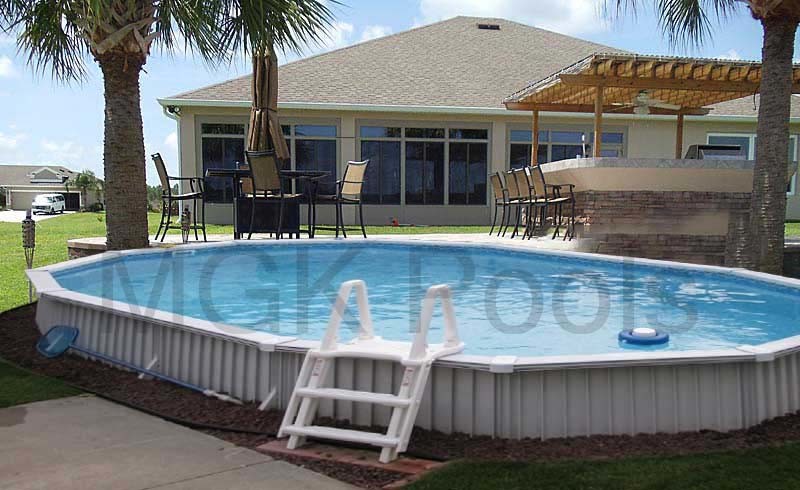
Why Traditional Pools Fail on Slopes
Let me explain why your pool contractor keeps telling you it’ll cost $80,000+ to put a pool on your hill.
Traditional inground pools (concrete/gunite/fiberglass) need a level hole in the ground. On a slope, that means one of three things:
- Massive excavation — Cut into the hill until you have a flat area large enough for the pool plus a patio. All that dirt has to go somewhere, usually on trucks at $500+ per load. On a significant slope, excavation alone can run $15,000–$30,000.
- Retaining walls — Build engineered walls to hold back the hill on the uphill side and/or support the fill on the downhill side. Depending on height and material, retaining walls cost $2,000–$30,000. Engineered block walls over 4 feet typically need a structural engineer’s stamp.
- Combination of both — Grade the high side, build up the low side, add retaining walls wherever the math doesn’t work. This is where you see inground pool projects on slopes hitting $80K–$120K.
Regular above ground pools need flat, level ground. On a slope, you have to either grade the entire area flat (expensive) or build a massive deck structure to create a level platform (also expensive, and now you’re swimming 6 feet in the air on the downhill side). Neither is a great option.
Semi-inground pools are the sweet spot, and it’s not even close. Here’s why.
How Semi-Inground Pools Solve the Slope Problem
Picture your sloped yard. The high side is, say, 3 feet higher than the low side across the area where you want a pool.
With a semi-inground pool, you simply bury the pool deeper on the high side and leave more exposed on the low side. The pool is level. The water is level. But the ground isn’t — and that’s perfectly fine.
On the uphill side, the pool wall might be buried 36 inches with just 16 inches showing above grade. On the downhill side, the full 52 inches of wall might be exposed. Add stone veneer, a wrap-around deck, or landscaping on the exposed portion, and you’ve just turned your “problem” slope into the best-looking pool on the street.
Or even better – Set the upper side like an inground pool, pour a deck, or build a patio from paver stones, or a combination of both. Semi inground pools offer the most design options.
No massive excavation. You’re digging to match the slope, not fighting against it.
No retaining walls (in most cases). The pool wall IS the retaining structure — it’s engineered to handle earth pressure on one side and water pressure on the other.
No leveling the yard. The pool adapts to the grade instead of forcing the grade to adapt to the pool.
This is what I do more than anything else. Semi-inground installations on slopes are our specialty. I’ve done hundreds of them across Massachusetts, New Hampshire, Connecticut, and Rhode Island.
The Two Pools I Trust on a Slope
Not every semi-inground pool is created equal, and on a slope the differences matter more. I sell and install two pools for semi-inground applications, and I won’t touch anything else for burial.
Aquasport 52 — The Value Champion
The Aquasport 52 uses interlocking 4-inch extruded aluminum panels that create a wall so strong you can bury it completely without a cement collar. Read that again: no cement collar required.
Every other semi-inground pool on the market — Radiant, Stealth, Optimum, Doughboy, Most Fox Ultimate’s — requires a concrete collar poured around the entire perimeter of the pool when buried more than about 24 inches. That collar costs approximately $2,500 in materials and labor, adds days to the installation.
The Aquasport 52 skips all of that. Its thick aluminum bottom track locks the interlocking panels in place and provides the structural resistance that other pools need concrete for. On a slope, this advantage is even bigger because:
- Faster installation — No waiting to backfill
- Lower cost — Save ~$2,500 on materials and labor
- More forgiving — On a slope, getting a concrete collar perfectly level around the entire perimeter is genuinely difficult.
- Better for DIY — If you’re a handy homeowner with access to a mini excavator, the Aquasport 52 is realistic to install yourself on a slope. I find the cement collar deters more DIYers than anything else.
Aquasport 52 on a slope — sizes and prices:
| Size | Kit Price (with liner) |
|---|---|
| 18′ Round | $6,031 |
| 21′ Round (most popular) | $6,860 |
| 24′ Round | $8,061 |
| 15×30 Oval | $9,920 |
| 17×32 Oval | $11,819 |
Installation on a slope: $5,300–$10,900 depending on size, burial depth, and bottom type (sand vs. vermiculite).
Full Aquasport 52 brochure with photo gallery →
Fox Ultimate — The Premium Option
The Fox Ultimate uses 14-gauge powder-coated galvanized steel panels. Most sizes require a cement collar when buried, but it offers things the Aquasport 52 doesn’t:
- Grecian and rectangle shapes — If you want something other than round or oval, the Fox Ultimate is your only option in this class
- Built-in inground step — An 8-foot, 5-tread thermoplastic stair integrated into the wall. This makes the pool look and feel exactly like a traditional inground pool. $3,400 add-on.
- Salt system compatible — The powder-coated steel handles salt without voiding the warranty (salt voids the Aquasport 52 warranty)
Fox Ultimate on a slope — popular sizes and prices:
| Size | Kit Price (with liner) |
|---|---|
| 21′ Round | $9689 |
| 24′ Round | $10,668 |
| 16×32 Grecian | $14,015 |
| 16×32 Rectangle | $14,959 |
| 18×36 Rectangle | $16,344 |
Installation on a slope: $8,800–$20,000 depending on size and complexity, plus ~$2,500 for the cement collar.
Full Fox Ultimate brochure with photo gallery →
How We Actually Install on a Slope (Step by Step)
Here’s what a real slope installation looks like. I’m going to walk through an Aquasport 52, since that’s what we install most often.
Step 1: Site Assessment and Staking
Before we touch a shovel, I visit your yard and measure the slope. We stake out the pool location, measure the elevation change from the high side to the low side, and determine how deep we need to bury on each side.
Rule of thumb: You want the top of the pool wall to be the same height all the way around when viewed from the finished patio level. On the uphill side, that means burying deeper. On the downhill side, you want it to be at grade or a foot deeper on larger pools.
We also check for:
- Underground utilities (call 811 before you dig — always)
- Water table depth
- Soil composition (ledge rock changes the plan)
- Drainage patterns (water has to go somewhere after rain)
- Setback requirements from property lines, septic, wells
Step 2: Excavation
We bring in a mini excavator and dig the hole. On a slope, this is more nuanced than a flat yard because we’re creating a level bottom at varying depths. The hole needs to be about 2–3 feet wider than the pool on straight sides and a foot on rounds and oval ends to give us room to work and backfill.
The excavated material either gets:
- Spread elsewhere on the property (if the homeowner wants it)
- Trucked away ($500–$1,500 depending on volume)
- Used as part of the backfill on the low side (only if you’re not building a patio — excavated dirt settles and is not suitable under pavers or concrete)
Step 3: Level the Bottom and Install the Pool
The bottom of the hole gets leveled, tamped, and prepared with a stonedust / paver pack base. Then we build the pool — set the bottom track, snap in the interlocking aluminum panels, install the top rails, and get everything plumb and level.
On an Aquasport 52, this goes relatively fast because there’s no concrete collar to deal with. We can build the pool, install the skimmer and return, and start filling with water the same day.
Step 4: Fill and Backfill
This is critical and where inexperienced installers screw up on slopes: you want to fill the pool with water first. you can damage the wall by backfilling first. On bigger Aquasport 52’s you don’t want to wait to long to backfill.
I use 3/8″ crushed stone for backfill — never excavated dirt. Crushed stone doesn’t settle, drains well, and provides consistent lateral pressure. Excavated dirt settles unevenly, holds water against the wall, and can cause problems for years.
PRO TIP: Wrap the pool wall in thick plastic sheeting before backfilling. This prevents direct contact between the crushed stone and the pool wall, which could scratch the coating over time and is an extra layer of moisture protection.
Step 5: Finish Grade and Patio
Once the pool is filled and backfilled, we grade the surrounding area to slope away from the pool (minimum 1/4 inch per foot). Then comes the fun part — the patio, decking, stone veneer, or whatever finish you’ve chosen.
On a slope, you have some fantastic design options:
- Flush deck on the uphill side — Walk right off your existing patio or deck and you’re at pool level
- Multi-level deck on the downhill side — Step down from pool level to a lower seating area
- Stone veneer on exposed wall — Makes the downhill side look like a custom-built stone retaining wall with a pool behind it
- Built-in seating walls — Use the elevation change to create bench-height walls around part of the pool
What About Drainage?
This is the question every slope installation has to answer, and it’s where experience matters most.
Water flows downhill. Your pool is now partially blocking that natural flow. If you don’t plan for drainage, groundwater accumulates behind the pool on the uphill side and causes hydrostatic pressure problems.
The solution is a French drain on the uphill side of the pool. This is a perforated pipe in a gravel trench that intercepts groundwater before it reaches the pool and redirects it around and away. It’s not expensive ($500–$1,500 depending on length), not required for all installations, depends on the prevailing grade and where water comes from above the pool.
Any installer who puts a semi-inground pool on a slope, or any pool really without addressing drainage is either inexperienced or cutting corners. Ask about it. If they can’t explain their drainage plan in detail, find someone else.
The Cost of NOT Dealing with Your Slope
Here’s what I see all the time: homeowners with sloped yards who decide to just put a regular above ground pool on the “flat-ish” part of the yard, usually the lowest point.
The problems:
- The “flat” part usually isn’t actually flat — it just looks flat-ish
- The low point of the yard is where water collects after rain
- The pool sits fully above ground, 52 inches tall, at the highest point of the property — maximum visibility to every neighbor
- They have to build a raised deck to access the pool, which costs $5,000–$15,000 and puts swimmers on an elevated stage visible to the entire neighborhood ruining the main purpose of a semi inground pool.
Then they realize they should have just invested in a semi-inground from the start. I’ve replaced more than a few above ground pools with Aquasport 52 semi-ingrounds for exactly this reason.
The math: $3,000 for the above ground pool + $8,000 for the raised deck + $6,500 for the Aquasport 52 replacement three years later = $17,500 total. They could have done it right the first time for $15,000–$20,000.
Real Slope Installations — What They Cost
Here are three real-world slope scenarios with actual costs:
Moderate slope, 21′ Aquasport 52, nice finish:
- 2-foot elevation change across pool footprint
- Pool kit: $6,860
- Excavation + Installation + plumbing: $8,500
- Backfill: $2,500
- Paver patio (one side): $10,000
- Equipment: $1,200
- Electrical/bonding: $3,500
- Total: ~$32,560
Steep slope, 15×30 Aquasport 52 Oval, upscale finish:
- 3.5-foot elevation change
- Pool kit: $9,920
- Excavation + Installation + plumbing: $9,500
- Backfill + French drain: $2,500
- Partial paver coping stones with poured concrete patio: $12,000
- Equipment: $1,500
- Electrical/bonding: $3,500
- Total: ~$38,920
Steep slope, 16×32 Fox Ultimate Grecian, full resort build:
- 3-foot elevation change
- Pool kit + liner: $14,015
- Excavation, Installation + cement collar + plumbing: $16,000
- Backfill + French drain: $3,000
- Inground step: $5,000
- Paver patio with coping: $14,500 (top side)
- Equipment: $2,500
- Electrical/bonding: $3,500
- Use excavated materials to raise the grade and level out the downhill side
- Total: ~$58,515
That last one looks and feels like a $100K+ inground pool. True story.
Full article about Semi inground pool cost
How to Get Started
If you’ve got a slope and you’re thinking about a pool, here’s what I’d do:
Step 1: Measure the slope. Walk from where you want the top of the pool to be down to where the bottom would be. How much of a drop is there? Take a photo from the side so you can see the grade. Hold a string or rope level and measure the distance from the ground to the rope.
Step 2: Check for utilities. Call Digsafe 811 and have your underground utilities marked before you make any decisions.
Step 3: Call me. Seriously. Send me a couple photos of your yard and your measurements, and I’ll tell you which pool makes sense, how deep we’d need to bury, and what it’ll realistically cost. No charge, no obligation, no salespeople.
Local customers: I’ll come out and do a site assessment in person. MA, NH, CT, RI, Southern ME. Check out our semi inground pool installation page
National customers: I ship the Aquasport 52 nationwide. Send me photos, your zip code, and your slope measurements, and I’ll put together a plan and walk you through the installation.
Call or text: (978) 710-8667
Email: Mike@mgkpools.com
Your slope isn’t a problem. It’s the best thing about your yard — you just don’t know it yet.
Mike Kern is the owner of MGK Pools Inc in Winchendon, MA, and has been installing semi-inground pools on New England slopes for over 30 years. He ships Aquasport 52 pools nationwide and is one of only three authorized dealers in the country. Browse the Aquasport 52 lineup →