
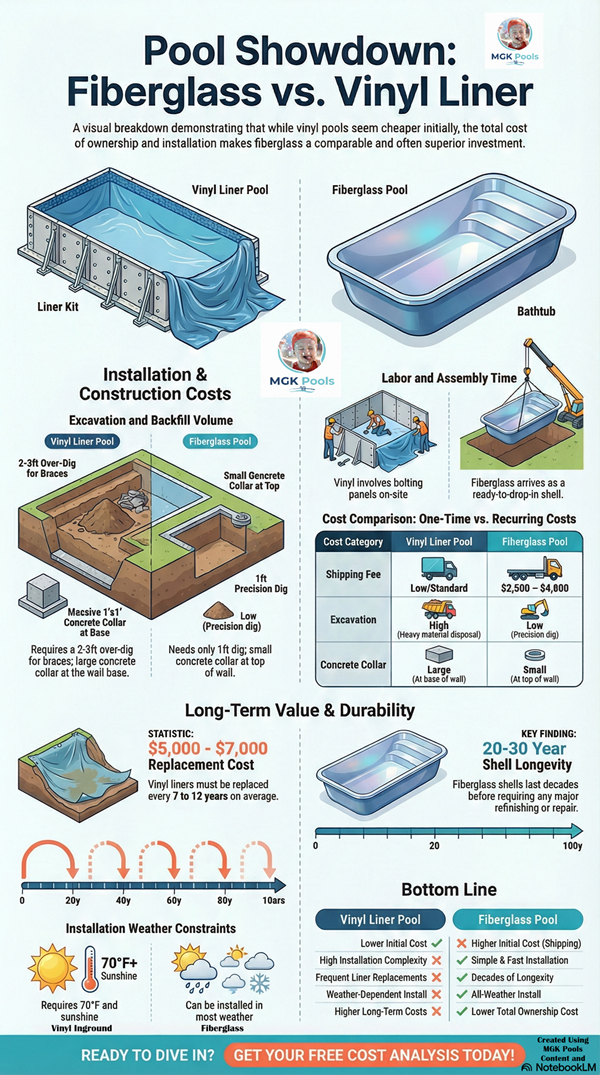
When comparing fiberglass pools versus vinyl inground pools, vinyl used to win hands down when it came to cost! The difference in price made sense — fiberglass is a better, more durable product, so you’d expect to pay more. Well, not anymore.
Summary for those who don’t want to read everything: If you just want a 20×40 rectangle with no extra design features like a tanning ledge, stadium stairs, swim-outs, etc., you’ll save a lot of money buying vinyl. If you want a custom shape, design features, and you’re okay with a maximum width of sixteen feet (most cases), then fiberglass wins every time.
I’m Michael Kern, a 30+ year pool industry veteran and CPO (Certified Pool Operator). I sell and install both, so I don’t have much of a conflict of interest. If I have any conflict, it’s this — I’m pushing 60 and fiberglass inground pools are easier to install and not as hard on my body.
POST Continues Below After Infographic:
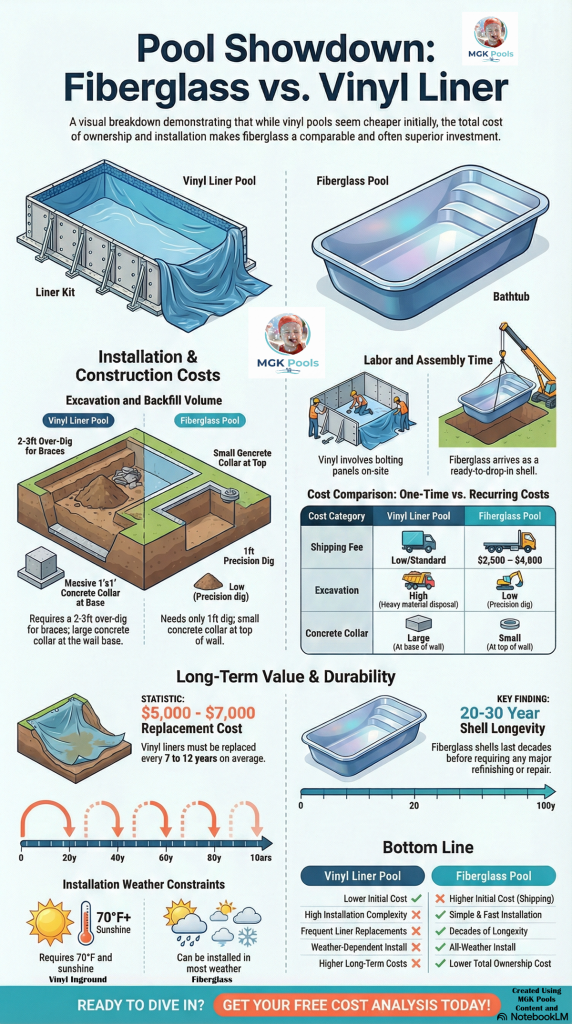
Inground Pool Cost; Fiberglass Vs Vinyl
There are a lot of parts to a vinyl inground pool, and where the kits used to cost a lot less than a fiberglass pool shell, that’s just not the case anymore. In certain cases, the vinyl kit does still cost less — maybe $6K–$10K less than a fiberglass shell when you combine shipping costs — but the labor, excavation cost, backfill materials, and disposing of excavated materials on those exceptions overtake the total cost almost every time. The only exception nowadays is for big, wide rectangle inground pools.
Excavation and Backfill
Vinyl inground pools have a steel or polymer wall — usually steel — and to keep the earth from pushing the walls in, or to keep the water from pushing the walls out, they use brackets shaped like an X or A-frame. They stick out almost 3 feet. If your pool is 16×32, you have to excavate a hole 22×38 feet. That is a lot of extra digging and dirt, rock, tree stumps, god knows what else compared to the precision 1-foot over-dig you need for a fiberglass pool.
But now you need to buy a whole lot more backfill once the walls are built. You need backfill because excavated material is not compactable — if you pour a concrete patio it will crack, and if you do paver stones they will settle unevenly. At $55 a yard for compactable backfill like 3/8″ crushed stone, there is a big difference between needing 20 yards and 90 yards.
With needing to get rid of all that extra excavated material, I hope there’s a free dumping site nearby. There are apps for that, and I know a few locations in my area, but every now and then you get stuck with dumping fees at $35/yard.
DIY Pro Tip: Have a dump truck on-site during excavation. No sense moving the material twice or trying to work around a lot — I mean a lot — of tall dirt piles.
Cement Collar
Both fiberglass and vinyl inground pools require a cement collar. Once you pound in all the rebar (2–3 pieces per panel) with vinyl pools, you pour a 1-foot deep concrete collar all around the whole pool, and if you have plastic steps you pack in the cement there up to the third step (roughly 3 feet). This is about 4–8 yards more than fiberglass pools depending on size.
Fiberglass pools don’t use a cement collar at the base like vinyl pools — they use one at the top. Fiberglass manufacturers want you to drill holes in the outer edge of the top lip and drop in candy cane rebar before pouring a 12-inch deep, 8-inch wide collar. This is a lot less cement, though forms are required.
Some installers like to take a shortcut with the fiberglass collar: they’ll do something called a monolithic pour, incorporating the patio and collar in one. We don’t recommend that, as the wall can move out of level or straightness.
DIY Pro Tip: Set your paver coping stones while doing the fiberglass cement collar. You use glue for the pool shell contact and cement for the rest of the paver stone.
Installation Labor
If it wasn’t clear, there is more labor to excavating and backfilling and doing the cement collar on a vinyl pool — not just more materials cost.
Now, both pools will require the same plumbing work and building a pad for the pool equipment. You might use the same equipment for either pool, though I would not recommend a salt cell on most steel wall pools as it is corrosive towards metal.
But with vinyl inground pools, every wall panel is bolted together with 9–12 sets of hardware. On taller walls there are what they call California braces at each connection. All these panels have to be flush and level. Every wall seam needs to be caulked and taped for smoothness behind the liner. Bead receiver has to get screwed to the top of the wall roughly every 6–8 inches, and of course you’ve also taped all the bead receiver screw heads so they don’t work against the vinyl liner. Then you have to do a type of cement bottom called vermiculite, or possibly do a grout bottom that has to be mixed, poured, and troweled. Installing those inground plastic steps — or steel steps if you’re crazy enough to do liner-over steps (really old school) — and lastly, once the floor dries, a super thorough cleaning before installing the pool liner. One pebble and you’re cooked. Installing a pool liner involves several people, setting vacuums, and often multiple adjustments to line up seams. And god willing, knock on wood, the liner was made right and there are no wrinkles.
Point of Reference: You don’t build fiberglass pools — they’re already built. You install them like a tub. Not a tub with a liner and a lot of parts, but just like your fiberglass bathtub. This seems like a good time to compare the cost of your bathroom tub to your new pool. If you know what you paid for your bathroom tub, you’ll start to think your new fiberglass pool isn’t so expensive.
Cool thing to know: You’ll never get a wrinkle in a fiberglass pool — the outer surface is what they call a gelcoat. The gelcoat is actually not waterproof, it’s porous. When water fills it in, the color changes a bit. The waterproofing in a fiberglass pool is in the ester resin used with the fiberglass to make the pool.
Fiberglass Versus Vinyl Inground Pool Maintenance
Long-term, you will need to replace the pool liner on average every ten years for a cost of $5K–$7K. The first time you might need to work on the fiberglass surface is likely after 25–30 years. This is why people say the maintenance cost is 30% less. They’re referring to this kind of maintenance, not how much chemicals it uses like chlorine.
One Place Vinyl Inground Pools Beat Fiberglass – Shipping
Shipping cost — fiberglass pools lose here every time. Average shipping costs have to do with distance from the manufacturer. For me in Massachusetts, it usually costs $2,400–$4,800 depending on pool size, especially pool width. My manufacturer is in New York, so they charge $2 a mile per follow car for the wide load. Some states require a permit, and for large fiberglass pools, often a police escort. But if you live in Connecticut or New York, it will cost less for some. Why less for some? Because while a lot of manufacturers have yards to pull from, the pools are actually manufactured down south where they don’t need to heat their warehouses.
Now, I’ve heard quotes of $10K–$15K for shipping to the middle of the country. It’s location, location, location. If you’re dealing with a pool builder or fiberglass pool installer that is buying from Canada but you live in the Carolinas, I suggest getting another pool installer.
Wrapping It Up
At the end of the day, for most pool shapes and sizes, fiberglass is going to cost you less to install and a lot less to maintain over the life of the pool. The only time vinyl really wins on price is when you’re going big and wide — think 20×40 rectangles — where fiberglass just doesn’t go (covered bridges, narrow roads). And shipping can close the gap depending on where you live.
There are always mitigating factors — yard access, soil conditions, what your town requires for permits — that can shift things one way or the other. Every backyard is different. If you’re local and trying to figure out which way to go, I’m happy to talk it through with you. No pressure, no pitch, just 30 years of doing this for a living.
One more thing before you go — if you’ve been reading this whole article thinking “I want an inground pool but I don’t want to spend $40K–$80K,” there’s a third option most people don’t know about. The Aquasport 52 is a semi-inground pool that gives you the inground look without the traditional inground price tag. It can be installed above ground, partially buried, or fully in the ground, and an all-in package installed starts around $20K. No cement collar, no wide-load shipping fees. Worth a look.
FAQ’s
Do Fiberglass Pools Use less Chemicals?
No! But if they do, it is so insignificant it doesn’t move the needle at all. Chlorine usage, for instance, doesn’t care what the surface of the bowl is. What matters is bather load, acid rain, amount of sunshine, and CYA (cyanuric acid) level. CYA is sunscreen for chlorine.
Here’s my theory on this myth: there are people out there I call affiliate ninjas. They make money by creating content, attracting viewers, and sending them through a link to buy something. This is how they make a living, that and ads on their websites. It’s a billion-dollar industry. I think someone who didn’t know the difference, stole the content and mistook “30% less maintenance” for chemicals. That, or propaganda from the fiberglass industry.
Can a fiberglass pool pop out of the ground?
Yes — same as a cement pool. If the groundwater is high and you drain your pool, it acts like a boat with the tide coming in. If it doesn’t completely come up, even a foot or two of lift can damage the structure. That’s why all fiberglass pools are installed with a dry well. Vinyl inground pools won’t float, but their liners can, and won’t reset properly all the time. Concrete pools are installed with a hydrostatic valve. So all three can be damaged, but it’s way worse if you drain your fiberglass or cement pool without first checking groundwater height.
How long does it take to install a fiberglass pool versus vinyl?
A fiberglass pool can be in the ground and swimming in about 1–2 days if permitting and weather are good, not counting patio. Vinyl inground pools typically take 1–2 weeks because you’re literally building the pool on-site — panels, walls, floor, liner. As I laid out in this article, there are a lot more steps involved.
Bonus Answer: Is it early spring or late fall? Because only fiberglass pools can be installed when the sun isn’t out or at least 65–70 degrees. Those are the prerequisites for installing a vinyl liner.
Are fiberglass pools good in cold climates like New England?
Absolutely. Fiberglass actually handles freeze-thaw cycles better than concrete because it flexes instead of cracking. I’m in Massachusetts and I install them here — they do great through our winters. The key is proper installation and backfill so the shell has room to move with the ground.
Even before I was installing these, back when I was a lowly service tech — before fiberglass pools were super popular in this area, close to 40 years ago — I never saw a problem, and I was the one de-winterizing them.