
My Grandmother Threatened to Blow Up Her Pool Every Year
True story.
Every spring, it took her three to four weeks to get that pool clear. She’d dump in clarifier, shock it to death, run the filter around the clock – nothing worked. She was ready to dynamite the thing.
What I know now, after 30+ years in this business that I didn’t know as a boy, is that her problem wasn’t the chemicals. It was her filter and how she used it.
She had a DE filter – supposedly the “best” type – but it was undersized for her pool, and she never added the right amount of DE powder. So this undersized filter, running without enough media, was basically just circulating dirty water.
I’ve seen the same thing hundreds of times on service calls. I’d show up to a frustrated homeowner’s backyard and find empty bottles of clarifier, jugs of chlorine everywhere, all the “solutions” the pool store sold them. They finally threw up their hands and called a pro.
Nine times out of ten, the problem was a dirty filter.
PRO TIP: Burn this into your brain, pool filters are not made big enough to clean a dirty pool. Yeah i said it! They are made and sized to keep a clean pool clear. If your pool has debris, get it out, if your pool is full of green algae, kill it and get it out, if there is a bunch of dirt in the pool, get it out FIRST, or plan to clean and refresh your filter 5-8 times. Seriously, I would show up with chemicals, an inground pump, a leaf rake, and a brush. Throw in the chemicals, brush the walls, and vacuum with my pump all the dead algae and sediment straight to waste, never try to filter it if your pool is dirty dirty.
The Dirty Secret About Pool Equipment Packages
Here’s something most pool dealers won’t tell you: they include cheap, undersized filters to hit a price point.
That Intex package with the “included filter system”? It wouldn’t be adequate for a Barbie dream house pool. It’s there so they can advertise a low number. You pay for it later in frustration, chemicals, and wasted weekends.
The savvy shopper researches filters before buying a pool. I hope that’s why you’re here.
The Three Types of Pool Filters (Quick Version)
I’m not going to write a dissertation. Here’s what you need to know:
Sand Filters – Least Efficient
⚡ TL;DR: Set it, backwash it occasionally, forget it. Lowest cost, least hassle, least precise.
Sand filtration is the oldest type of pool filter — it’s been around since the roman empire. The filter tank is filled with high-grade silica sand, and water passes through it, trapping particles in the sand bed. Sand media typically lasts 5 to 15 years before it needs replacing.
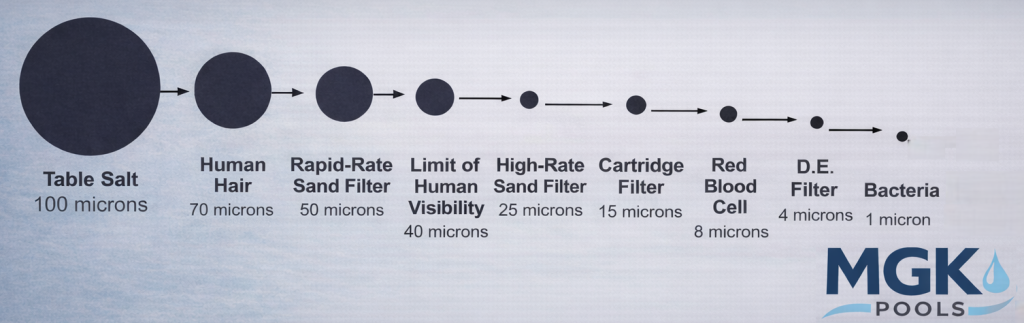
There are two types worth knowing: high-rate sand filters (the most common for residential pools) catch particles down to about 25 microns. To give you a sense of scale, a human hair is 70 microns and the limit of human visibility is 40 microns — so a properly sized, high-rate sand filter is actually filtering out things you can’t even see with the naked eye. Not bad for the “worst” filter type.
- Maintenance: Backwash when pressure rises 8-10 psi above normal — no disassembly needed, easy to winterize
- Best for: Budget-conscious buyers, people who want the simplest possible maintenance routine
- The honest take: Sand gets a bad rap, but for someone who wants simple maintenance and a low price, it’s a solid choice. Backwash, done.
Micron scale
Cartridge Filters – Middle Range
⚡ TL;DR: Better filtration than sand, less hassle than DE. The sweet spot for most backyard pools.
Cartridge filters use a pleated polyester element — think of it like a really fancy coffee filter — to trap particles in the 10 to 25 micron range. That’s meaningfully better than sand, and since there’s no backwashing, you’re not wasting water every time you clean it. You just pull the cartridge, hose it off, and drop it back in.
One thing the pool store won’t tell you: cartridge filters are more sensitive to high water velocity than any other filter type. If you’re pushing too much water through too fast, dirt and oils can actually get driven through the cartridge and back into your pool. This is exactly why I always pair a cartridge filter with a variable speed pump — slow the water down and let the filter do its job properly.
- Maintenance: Remove cartridge, hose it off a few times per season. Soak in filter cleaner once a year.
- Best for: Most pool owners, anyone who wants better filtration without dealing with DE powder
- The honest take: This is what I recommend most often. Good balance of performance and ease.
DE (Diatomaceous Earth) Filters – The Best
⚡ TL;DR: Crystal clear water. Catches almost everything. Worth the little extra maintenance if water clarity matters to you.
DE filters use fossilized skeletons of microscopic sea Diatoms — literally tiny prehistoric creatures — to trap particles as small as 2 to 6 microns. For reference, a red blood cell is 8 microns. DE filtration catches things that are smaller than a red blood cell. Sand and cartridge filters aren’t even in the same conversation at that level.
That’s why pool water with a properly sized DE filter looks like liquid glass. It’s not magic — it’s prehistoric plankton working overtime.
The trade-off is maintenance. DE is considered a disposable media — after each cleaning, you have to add fresh DE powder to recharge the filter. Skip that step and you’ve basically got an empty tank circulating dirty water (ask my grandmother how that worked out). The bump handle design on the Hayward EC series lets you extend cleaning cycles without fully disassembling — a nice practical feature.
- Maintenance: Disassemble and clean, then recharge with fresh DE powder. Must do this right or the filter does nothing.
- Best for: Water clarity perfectionists, night swimmers, anyone who wants the absolute best filtration available
- The honest take: If you want the clearest water possible and you don’t mind a little more maintenance, DE is the answer. There’s a reason pros use it. This is all I would use if it were me.
The micron numbers and particle size comparisons come straight from the Pool & Hot Tub Alliance CPO manual (12th Edition) — the industry certification textbook. So when I say DE catches particles smaller than a red blood cell, that’s not marketing copy. That’s the science.
Size Matters as much as Type
You cannot oversize a pool filter. Bigger is always better.
A larger filter means:
- Longer time between cleanings
- Better water flow
- Less strain on your pump
- Faster clearing when you open in spring
Above Ground Filter Systems | What I Actually Recommend (and Sell)
I only carry products I’d put on my own pool. Here’s my honest equipment ladder:
Best Value for Smaller Above Ground Pools
SPLA 120 sq ft Cartridge + 2-Speed Pump Package
- Oversized for pools up to ~9,000 gallons / decent size for a 24 round size pools
- Great value, reliable, gets the job done
- Have had better satisfaction than with Hayward
Best All-Around for Above Ground Pools
Hayward XStream 150 Cartridge Filter System + Speck E71-II Variable Speed Pump or Hayward 2-Speed Pump
- My go-to recommendation for most above ground and semi-inground pools
- Complete system: filter, hoses, clamps, union, gauge, base/platform
- Variable speed pump = serious energy savings
- Works for semi-inground pools if the pump is below waterline (gravity feed)
Best DE Filter for Above Ground
Hayward EC40/45/50 Series DE Filters
- If you want DE filtration for an above ground pool, this is the one
- Bump handle for extended cleaning cycles
- Rock solid reliability
Money No Object
Pentair DE Quad 60
- An inground filter, but works beautifully on larger above ground and semi-inground pools
- Massive capacity = clean your filter once a year when you close the pool – that’s it
- The Cadillac of pool filters – You are going to shell out roughly $800 more but you will love your life!
Inground Filters
Sand is sand, Sand filters have been around and working fine since the Roman days (Think Chariots of Fire). And they cost the least. Really a commodity, so the brand doesn’t even matter. It’s the sand that filters the dirty water and algae, so just get one that holds a couple hundred pounds of sand (recommend white Silica filter sand).
Cartridge Inground Filters – Most are either Hayward or Pentair – I prefer Pentair mainly because they keep innovating and their customer service, and tech support is 20X better than hayward. Pentair has a great line of cartridge inground filters called Clean and Clear
DE is the Best – Just a fact! My go to is Pentair Quad 60, but for larger pools, maybe size 20×40, I’d go with the Quad 80.
Bottom Line
Don’t let a cheap filter ruin your pool experience. Whether you go sand, cartridge, or DE – get one that’s properly sized for your pool.
And if you’re buying a pool package? Make sure you know what filter is included..
Questions? I’ve been doing this for 30 years. [Call me] or [browse pool packages].
FAQs
How often should I clean my pool filter?
It’s not a weekly, monthly, or calendar event. You clean your filter when the pressure gauge reads 8-10 psi higher than just after you clean it well. Every pool is different, as are the filters and filter sizes. A heavily used pool with lots of swimmers, sunscreen, and debris will need cleaning more often than a pool that gets light use. The pressure gauge is your filter talking to you. Listen to it. If you get used to the current coming back to the pool, you will notice it weaken before the gauge moves.
This question actually deserves a much longer answer — I wrote a whole guide on it: [How Often Should You Clean Your Pool Filter? The Real Answer]
How many hours a day should I run my pool filter?
Long enough to turn your entire water volume over at least once. For most above ground pools with a properly sized pump, that’s 8 hours at high speed. But here’s the better answer: if you have a variable speed or two speed pump, run it 22-24 (22 for DE) hours a day at low speed. You’ll use less electricity than running it 8 hours at full blast, and your filter will do a much better job because slow water is easier to clean than fast water, plus your skimmer will catch more debris with the longer run time..
Can I use an Above Ground Filter on an Inground Pool?
Yes, but only if you have a variable speed pump. Inground filters are designed for inground pumps that move 80 gallons a minute. Above ground filters are designed to handle 30 gallons a minute, so if you cut the speed way down on the pump you can use the above ground filter.
What’s The Best Pool Filter?
A: DE (Diatomaceous Earth) filters filter out the smallest particles, The comes cartridge, then sand filters come in last.
Is DE powder dangerous?
Only if you breathe it in dry — the fine particles can irritate your lungs, similar to any fine dust. Wear a dust mask when you’re adding it to the filter, don’t do it on a windy day, and you’re fine. Once it’s mixed with water inside the filter it’s completely harmless. DE is actually food-grade diatomaceous earth, the same stuff people put in their gardens. Just don’t inhale the dry powder and you have nothing to worry about.
Which Pool Filters Cost the Least?
A: The cheapest pool filters are sand filters.
Which Above Ground Pool Filter do I recommend the Most?
A: The Hayward XStream 150 cartridge filter, and I like to pair it with a 2-speed or variable speed pump. The slower you move pool water the easier it is for your filter to clean the water.